
Your baby is only a couple of weeks old. They look so small on the change mat, their tummy feels tight, and you have read that a massage can help with wind. Then you look down at the umbilical cord stump, or the fresh belly button, and you stop. How gently is gently? Is it too soon?
Those are good questions. A newborn is not simply a smaller version of an older baby, so a massage for a newborn needs to be shorter, lighter and more flexible. This page gives you a three-minute routine built for those early weeks, including what to do before the belly button has healed.
At a glance
- Wait until the umbilical cord stump has come away and the belly button has healed before you stroke the tummy. Until then, use leg moves instead
- Three minutes is enough: resting hands, small clockwise circles, downward strokes, then knees to tummy
- Use light, slow pressure with flat fingers
- Wait at least half an hour after a feed, and choose a time when your baby is calm and alert
- Your baby’s cues decide when to stop
Is My Newborn Old Enough?
Gentle touch is fine from the early days. The main thing to work around is the belly button.
The cord stump usually falls off after about 5 to 14 days. Until the area is dry and healed, keep your hands and any oil away from it. A little ooze around the time the stump comes away is normal. If the area is red, warm, swollen or smelly, or has cloudy ooze, see your midwife or doctor as soon as possible.
How to tell it has healed. Wait until the area stays dry, with no ooze or smell. Until then, fold the nappy below the area so air can reach it. If you are not sure, ask your midwife or child health nurse at your next visit.
If your baby was born early or has a health condition, ask your child health nurse before you start.
Before the Belly Button Has Healed
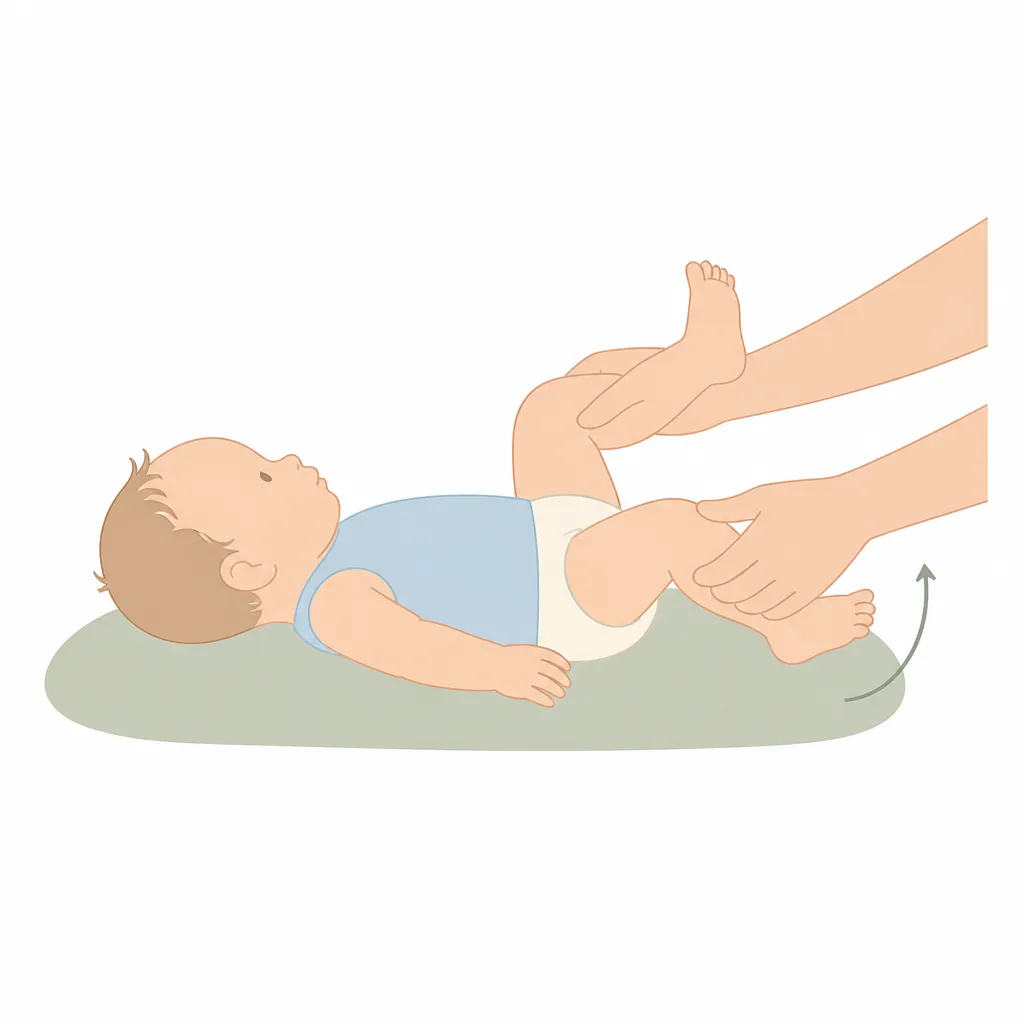
You can still help wind along in the very first weeks without touching the tummy. Try these instead.
- Bicycle legs. Hold your baby’s lower legs and cycle them slowly, a few rotations at a time
- Knees up, then down. Bring both knees gently towards the tummy, stopping well before they press on the stump
- Back strokes. With your baby upright against your chest, stroke slowly and lightly up their back
- Holds. Our guide to gas relief holds for newborns shows you upright options that keep pressure away from the stump
Getting Ready
The set-up matters more with a newborn, because they get cold quickly and can tire fast.
- Warm the room and your hands. Newborns lose heat quickly, so keep a towel handy to cover their chest and legs
- Choose your moment. Wait at least half an hour after a feed. Look for a calm, alert baby with open eyes and a relaxed face
- Use a safe surface. A towel on the floor or on a change mat is ideal. Keep one hand on your baby if they are up on a change table
- Skip the oil if you like. Bare hands are fine. If you use oil, choose a small amount of plain, unscented massage oil, and keep it away from a healing belly button
The Three-Minute Routine
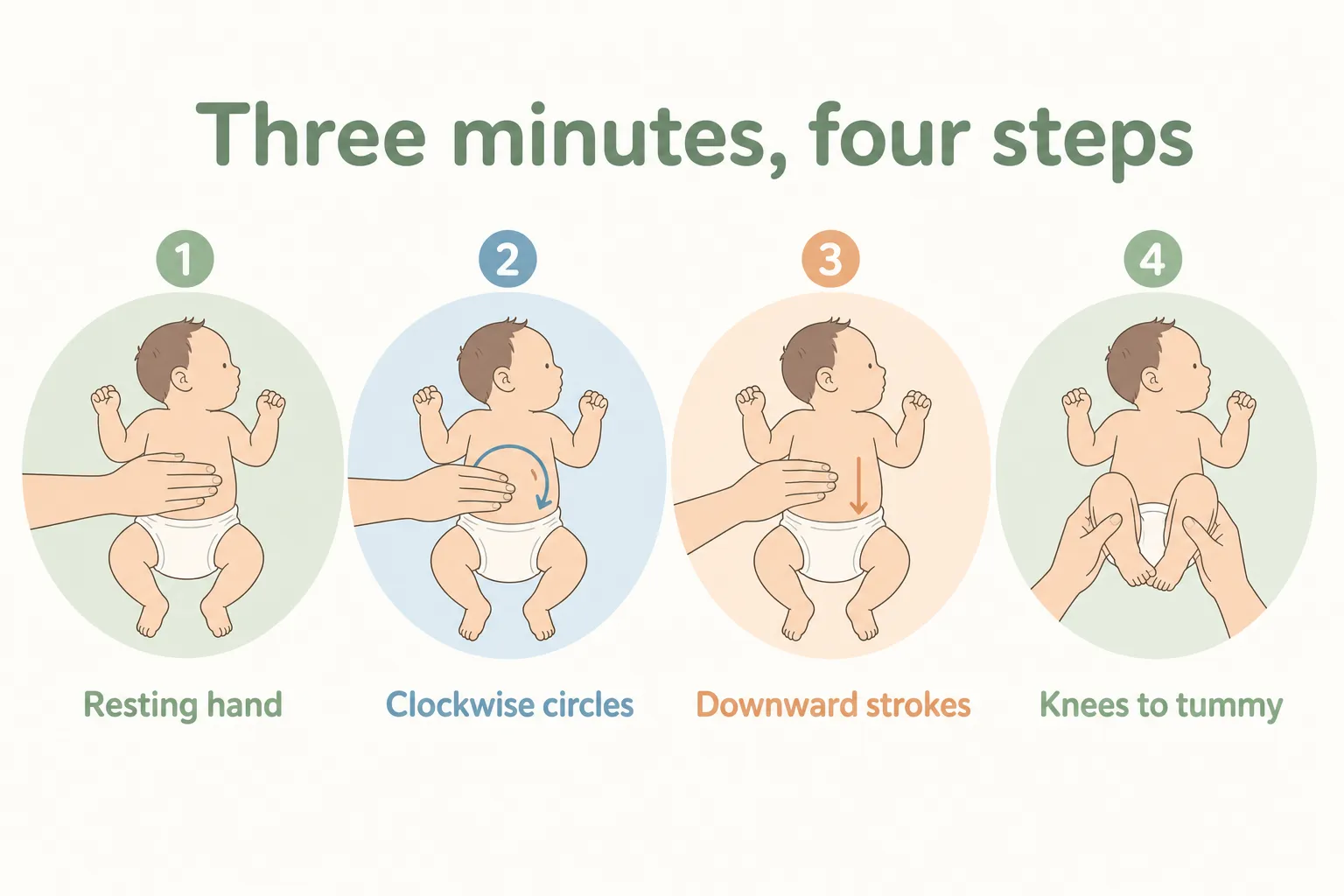
Do each step slowly. If your baby is happy, you can repeat a step. If not, stop there. Doing one step is better than pushing through all four.
Step 1. Resting hands (about 30 seconds)
Rest one warm, still hand on your baby’s tummy. On a tiny baby, one hand usually covers it. Talk or hum quietly, and wait for their tummy to soften a little under your palm.
Step 2. Small clockwise circles (about one minute)
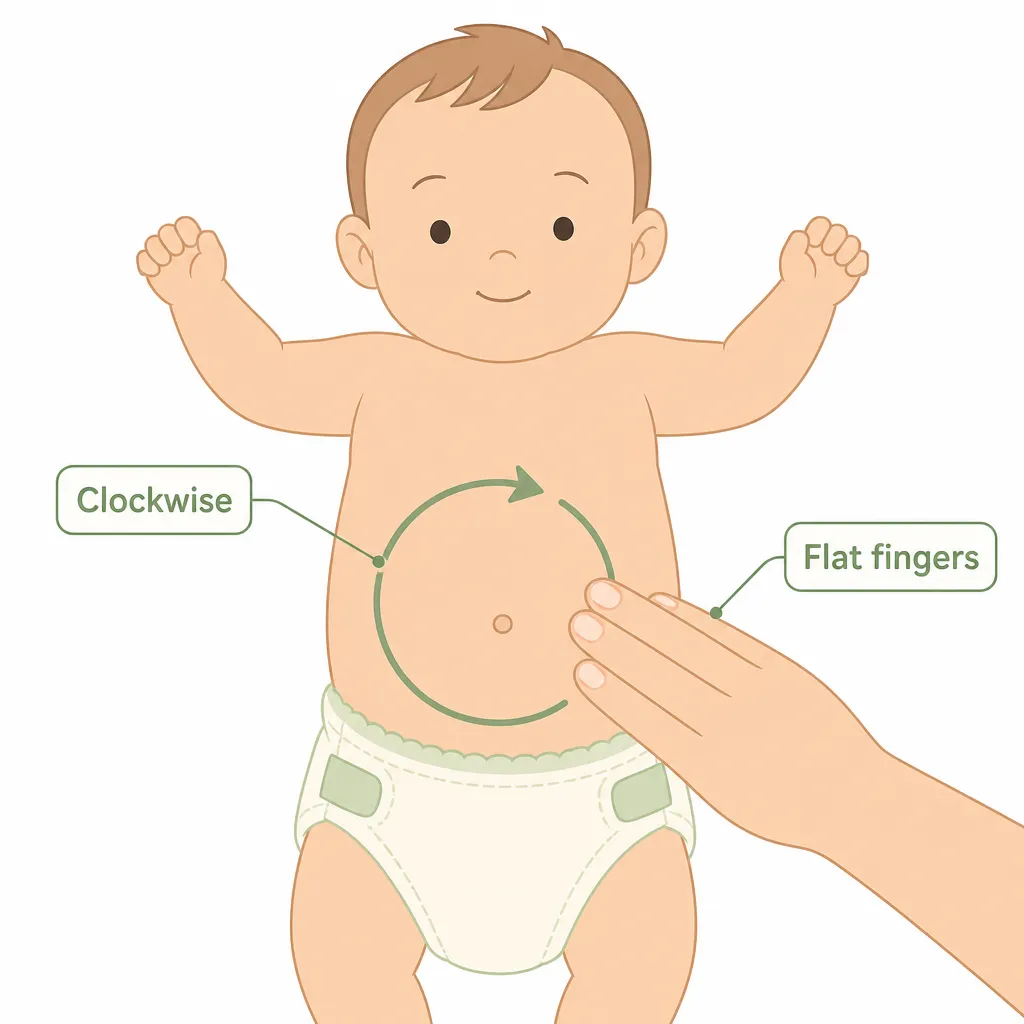
Use two or three fingertips, kept flat, not digging in. Make small, slow circles around the belly button, staying a little way out from it. Move clockwise as you look down at your baby. That is the direction wind travels through the gut. Make six to ten circles.
Step 3. Downward strokes (about 30 seconds)
With the flat of your fingers, stroke slowly downwards from just under the ribs to the top of the nappy. Lift your hand, go back to the top and repeat, as if you are smoothing a blanket. Six strokes is plenty.
Step 4. Knees to tummy (about 30 seconds)
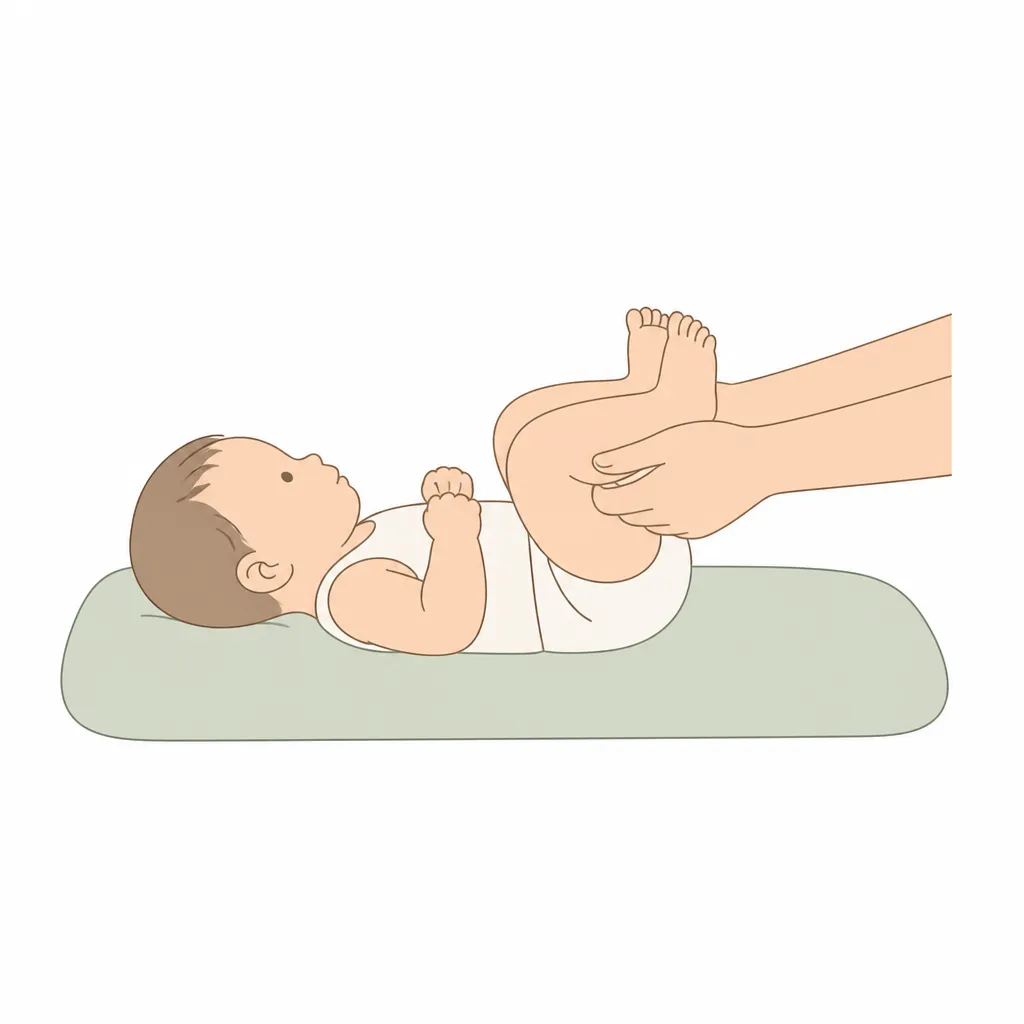
Hold your baby’s lower legs and gently bring both knees up towards the tummy. Hold for a slow count of three, then let the legs straighten. Repeat three or four times. This is the step that most often produces a bottom burp, so be ready for it.
Finish with a resting hand for a moment, then dress your baby and pick them up for a cuddle. A few minutes upright after the massage can help any air that has shifted.
How Much Pressure Is Right?
Most parents worry about pressing too hard, which is a good instinct. You are aiming for contact and warmth.
- Start with a soft tummy. If the tummy feels hard or tight and your baby does not relax under a resting hand, skip the massage today
- Keep your fingers flat. Your fingers should glide with slow, gentle contact and never dig in. If you can see a dent, ease off
- Watch your baby, not your hands. If your baby tenses, go lighter or stop
As your baby grows, you can use your whole hand and slightly more contact. Our step-by-step guide to baby massage for colic and wind has the longer routine, with the water wheel, the sun and moon and the I Love U, for when your baby is ready for more.
Reading Your Baby’s Cues
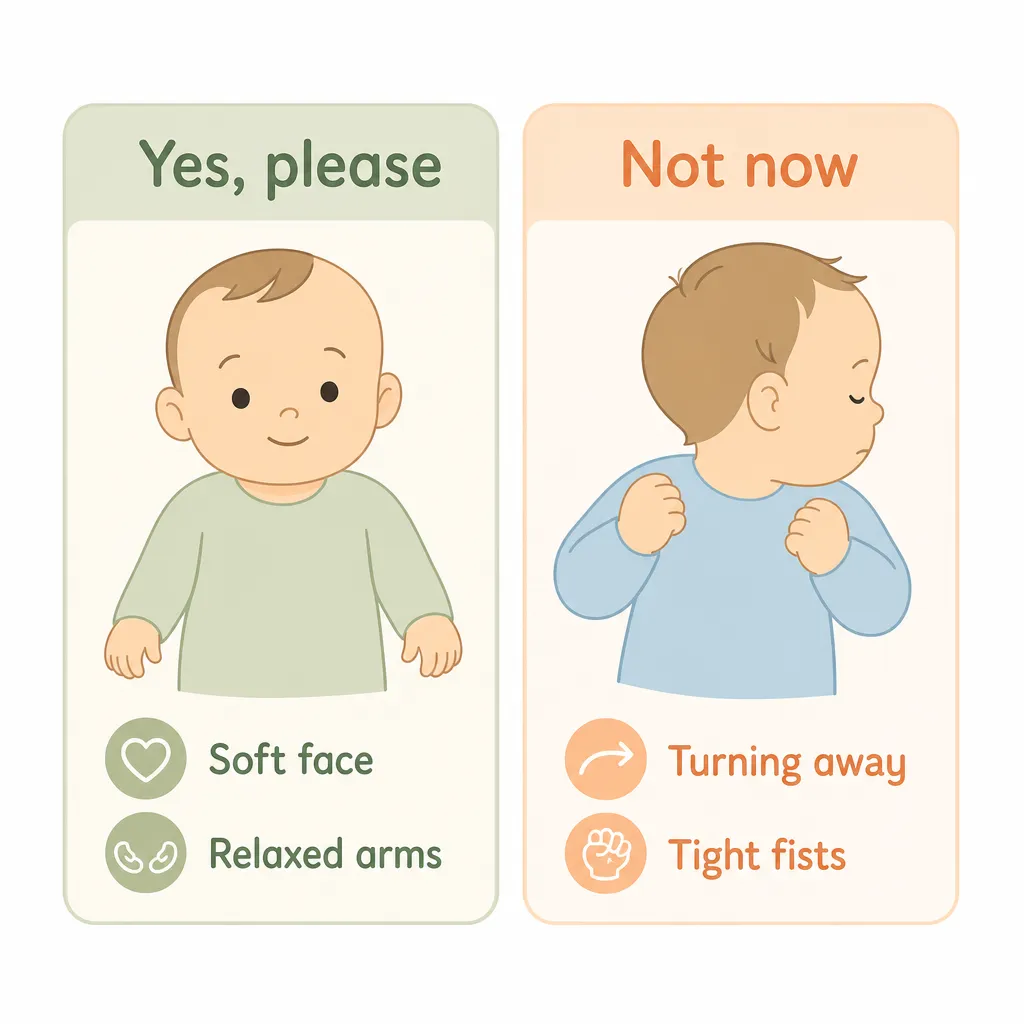
A newborn cannot tell you what they want, but they can show you.
| Your baby is saying yes | Your baby is saying not now |
|---|---|
| Soft face and open eyes | Turning their head away |
| Relaxed arms and legs | Stiffening, arching or tight fists |
| Looking towards you | Hiccups, yawning or looking away repeatedly |
| Quiet sounds | Fussing or crying |
A “not now” does not mean you are doing it wrong. Your baby may be hungry, tired or simply finished for the moment. Try again another day. Many newborns get to enjoy massage after a few short, calm tries.
When to Do It
Once or twice a day is plenty. Good moments include a quiet time after a nappy change, or after a bath in a warm room. A mid-afternoon session can also be a good way to get ahead of the evening.
Skip massage straight after a feed, in the middle of a big cry, when your baby is unwell or feverish, or when they have just had their immunisations, unless your nurse says otherwise.
If your baby is already crying hard, settle them first with a hold. Massage works best between episodes rather than during them. Our guide on how to relieve infant gas shows where massage fits in a whole day, and our guide on how to release trapped wind in babies is useful when wind has moved low and your baby is straining.
If Massage Does Not Seem to Help
Massage is one small tool, and it will not suit every baby every day. Give it three or four days before you judge it, and look for small changes, such as an easier afternoon or a quicker bottom burp. If your baby cries for long stretches and follows the same pattern each day, the colic quiz can help you think it through.
Where a Herbal Remedy Fits
Alongside hands-on care, many Australian families use Infants’ Friend Colic & Wind, a traditional herbal remedy given by mouth with feeds. Its ingredients are traditionally used in Western herbal medicine to relieve colic symptoms, wind and gas pain and mild indigestion in infants, and it is alcohol-free and suitable from birth when used as directed.
When to Talk to Your GP or Child Health Nurse
If your baby is under three months old and has a temperature of 38°C or higher, go straight to the nearest emergency department or call 000, even if they seem otherwise well. Call 000 if your baby of any age is floppy, hard to wake, struggling to breathe or vomiting green fluid.
Wind is common and usually eases as your baby grows. Still, trust your instincts. If your baby is older and has a fever, vomits often or forcefully, refuses feeds, is not gaining weight, has fewer wet nappies, has a swollen tummy that stays hard and tender, or simply seems unwell to you rather than uncomfortable, have a chat to your GP or maternal child health nurse. Do not massage a tummy that seems sore.
Always read the label and follow the directions for use. If symptoms persist, talk to your health professional.
Infants’ Friend Colic & Wind (AUST L 367810) contains ingredients traditionally used in Western herbal medicine for colic relief (wind/gas pain). Available Australia-wide since 1935.
Frequently Asked Questions
AUST L 367810. Always read the label and follow the directions for use. If symptoms persist, talk to your health professional.