
When you are pacing the hallway at 9pm with a crying baby, one question matters more than almost any other: how long does this last? Colic can feel endless from the inside, so it helps enormously to know that it follows a surprisingly predictable arc, with a beginning, a peak and, mercifully, an end.
This page maps out that arc: when colic typically starts, when it is at its worst, when it stops, and how to get through the weeks in the middle.
The Short Answer
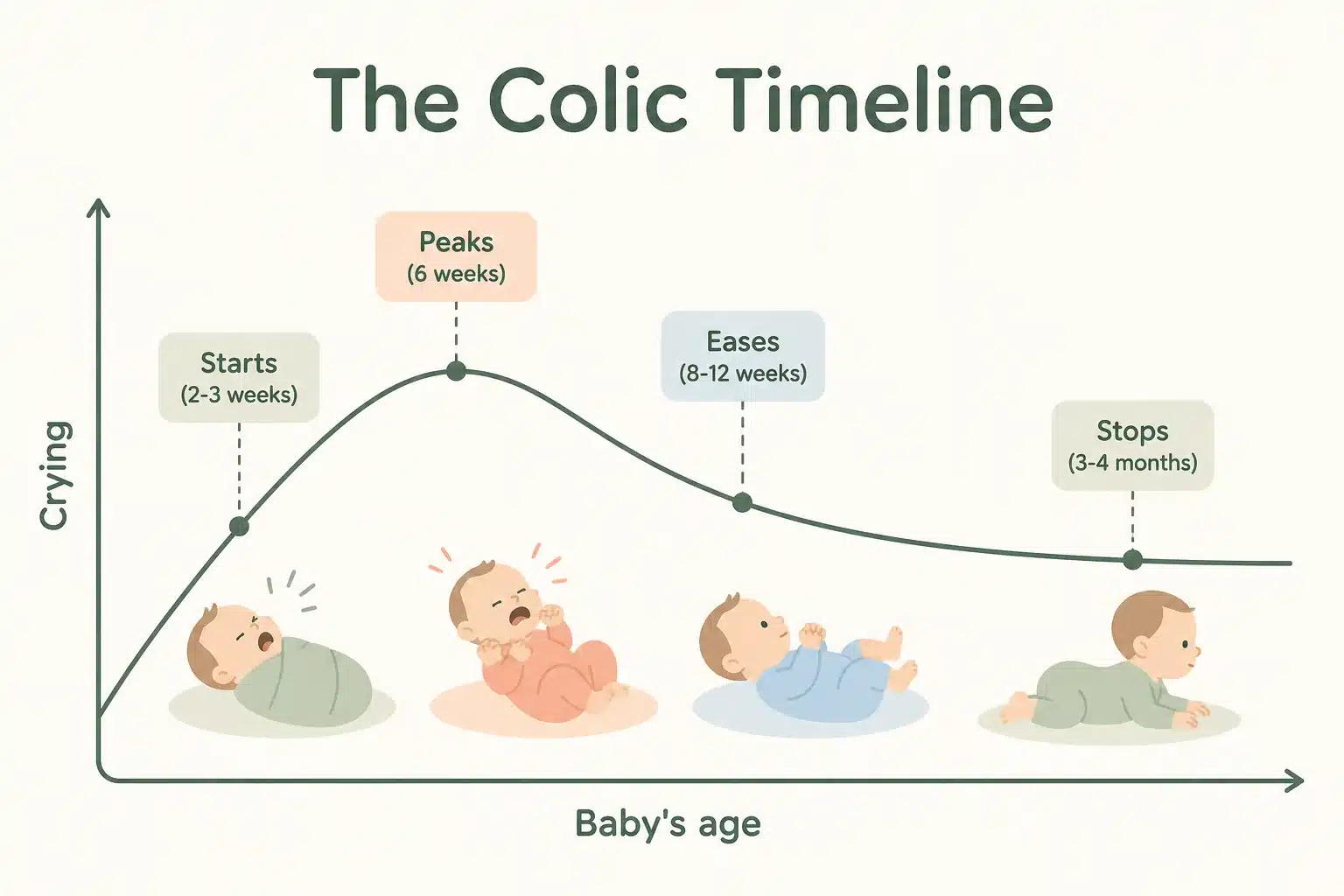
For most babies, the colic timeline looks like this:
| Stage | Typical timing |
|---|---|
| Colic starts | Around 2 to 3 weeks of age |
| Colic peaks | Around 6 weeks of age |
| Colic eases | From about 8 to 12 weeks |
| Colic stops | Usually by 3 to 4 months |
Every baby is different, and some run a little earlier or later than this. But if your baby’s crying ramped up out of nowhere in week two or three, you are looking at a textbook colic pattern, not something you caused.
A Quick Refresher: What Colic Is
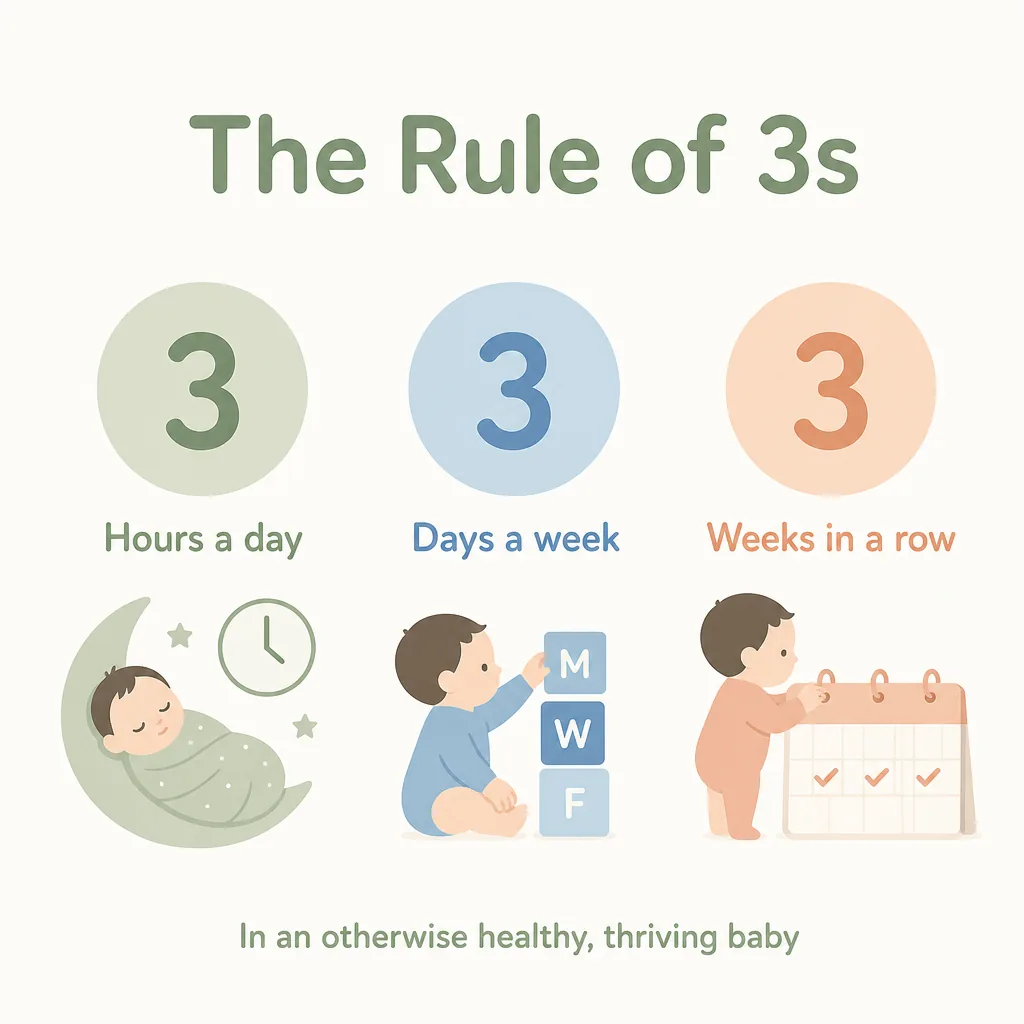
Colic is frequent, intense, hard-to-explain crying in a baby who is otherwise healthy, feeding and growing well. The traditional yardstick is the rule of threes: crying for more than three hours a day, on more than three days a week, for at least three weeks. Episodes tend to cluster in the late afternoon and evening, and during them babies often clench their fists, arch their back and pull their knees up to their tummy.
If you are still working out whether what you are seeing is colic, start with our guide to what colic is in babies or run through the signs of colic in newborns. This page assumes colic is the likely story and focuses on the timing.
When Does Colic Start?

Colic typically begins when a baby is around two to three weeks old. That timing catches many parents off guard, because the first fortnight is often deceptively calm, full of sleepy feeds and visitors saying how easy the baby is. Then, seemingly overnight, the evening crying arrives.
An earlier or later start is still within normal range. Some babies show colicky crying from the second week, others not until week four or five. In premature babies, colic tends to follow the due date rather than the birth date, so it often starts around two to three weeks of corrected age.
The start of colic lines up with a real developmental shift. Around this age, babies wake up to the world: feeds get bigger, digestion is working harder than it ever has, and their nervous system is taking in vastly more stimulation. Their little systems are simply not seasoned yet, which is why this stretch is often called the fourth trimester. Understanding what causes colic in babies will not switch the crying off, but it does make the timing make sense.
When Does Colic Peak?

Crying, colicky or otherwise, builds to a peak at around six weeks of age. If week five feels harder than week three, that is not you failing, that is the curve doing what the curve does.
Around the peak, the daily pattern usually sharpens as well. Crying concentrates into the late afternoon and evening, the notorious witching hour, and episodes can stretch for two or three hours despite your best settling work. It is intense, and it is also the top of the hill. From here, the trend bends downward.
The peak weeks are when parents most need a plan and a break. We cover both below.
When Does Colic Stop?

Colic fades gradually through the two to three month stretch, and for most babies it has resolved by three to four months of age. A smaller number of babies, particularly those who started late or were born early, take until around five or six months to fully settle.
Two things are worth knowing about the ending. First, it is usually a fade rather than a full stop: the evening crying gets shorter and less intense across a few weeks, with the odd bad night mixed in. Second, improvement is not perfectly linear. A rough evening after a string of good ones does not mean colic is back to stay, it usually means your baby had a big day.
By around four months, most families find the evening storm has passed and the baby who screamed through July is grinning at the ceiling fan in September.
The Colic Timeline, Week by Week
| Age | What you will typically see |
|---|---|
| 0 to 2 weeks | Usually a settled stretch. Crying is mostly about hunger, nappies and tiredness |
| 2 to 3 weeks | Colic begins. Unexplained evening crying appears and daily crying totals climb |
| 4 to 6 weeks | The climb to the peak. Evening episodes lengthen and intensify, often 2 to 3 hours |
| 6 to 8 weeks | The peak, then the first signs of easing. Hard weeks, but the top of the curve |
| 8 to 12 weeks | Steady improvement. Episodes shorten, calm evenings start to outnumber rough ones |
| 3 to 4 months | Colic resolves for most babies. Occasional fussy evenings, but the pattern is gone |
Keep in mind this is the typical arc, not a contract. Babies have not read the timeline.
Why Colic Follows This Pattern
The neat rise and fall of colic tracks a few developmental threads that all mature over the same window:
- Digestion is brand new. A newborn gut is processing milk around the clock for the first time, and wind is harder to move along an immature digestive tract. As the gut matures over the first three months, that discomfort eases. Trapped wind and colic are close companions, which is why wind relief features so heavily in colic care.
- The nervous system is still calibrating. Young babies cannot yet filter noise, light and handling, so stimulation accumulates through the day and spills over as evening crying. Their ability to self-settle, sucking hands, turning away, tuning out, only comes online over the following months.
- Crying itself follows a curve. All newborn crying, colicky or not, rises from around two weeks, peaks near six weeks and declines by month three or four. Colic sits at the intense end of that same universal curve.
The practical takeaway: colic ends because your baby matures, not because you eventually find the one perfect fix. Your job through the middle is comfort and survival, not cure.
Getting Through the Peak Weeks

A few things genuinely help while you are inside the curve:
- Have an evening routine ready before the crying starts. Feed with plenty of burping, dim the lights, then work through a calm cycle of settling techniques. Our guide to soothing a colicky baby covers holds, sound and movement in detail
- Work on wind through the day. Regular burping and positions that help wind move can lower the evening pressure. See 10 ways to relieve trapped wind
- Consider a traditional herbal remedy. Infants’ Friend Colic & Wind blends chamomile, lemon balm and dill seed oil, herbs traditionally used in Western herbal medicine to relieve colic symptoms, wind and gas pain, and mild indigestion in infants. It is suitable from birth when used as directed and is available at Coles, Woolworths and Chemist Warehouse. See our where to buy page
- Share the evenings. Split the peak-hour shift with your partner or accept a standing offer of help. The peak weeks are a marathon mile, not a sprint
- Mark the milestones. Six weeks is the top of the hill. It genuinely helps to know that on the hard nights
When It Might Be More Than Colic
Timing is one of colic’s most useful tells, and breaks in the pattern are worth a conversation. Check in with your GP or maternal child health nurse if:
- Crying starts suddenly in a baby older than about three months, or colic seems to appear for the first time well past the usual window
- The crying is constant through the whole day rather than clustered into episodes
- Your baby has a fever, vomiting, diarrhoea, poor weight gain or fewer wet nappies
- The cry sounds unusual to you, weak or high-pitched, or your baby seems floppy or unwell
- Symptoms like rashes, mucus in poo, or feed refusal make you wonder about something like cow’s milk protein intolerance, or frequent spilling with distress makes you think of reflux
And a standing rule: if your gut says something is off, see your GP. A normal check-up is never a wasted trip.
Infants’ Friend Colic & Wind (AUST L 367810) contains ingredients traditionally used in Western herbal medicine for colic relief (wind/gas pain). Available Australia-wide since 1935.
Frequently Asked Questions
AUST L 367810. Always read the label and follow the directions for use. If symptoms persist, talk to your health professional.