
The first weeks with a newborn are intense. Some crying is completely normal – newborns cry for feeds, comfort, warmth, sleep, and sometimes for reasons that aren’t clear at all. But when the crying becomes long, hard to soothe, and follows the same pattern day after day, many parents start to wonder: is this colic?
This guide focuses on what colic looks like specifically in newborns – roughly the first 6 weeks – how to tell it apart from normal newborn fussiness, the red flags worth watching for, and when it’s time to pick up the phone to your maternal child health nurse or GP.
For a broader symptom inventory across the whole 0-4 month colic window, see our guide on colic symptoms and signs in babies.
When does colic start in newborns?
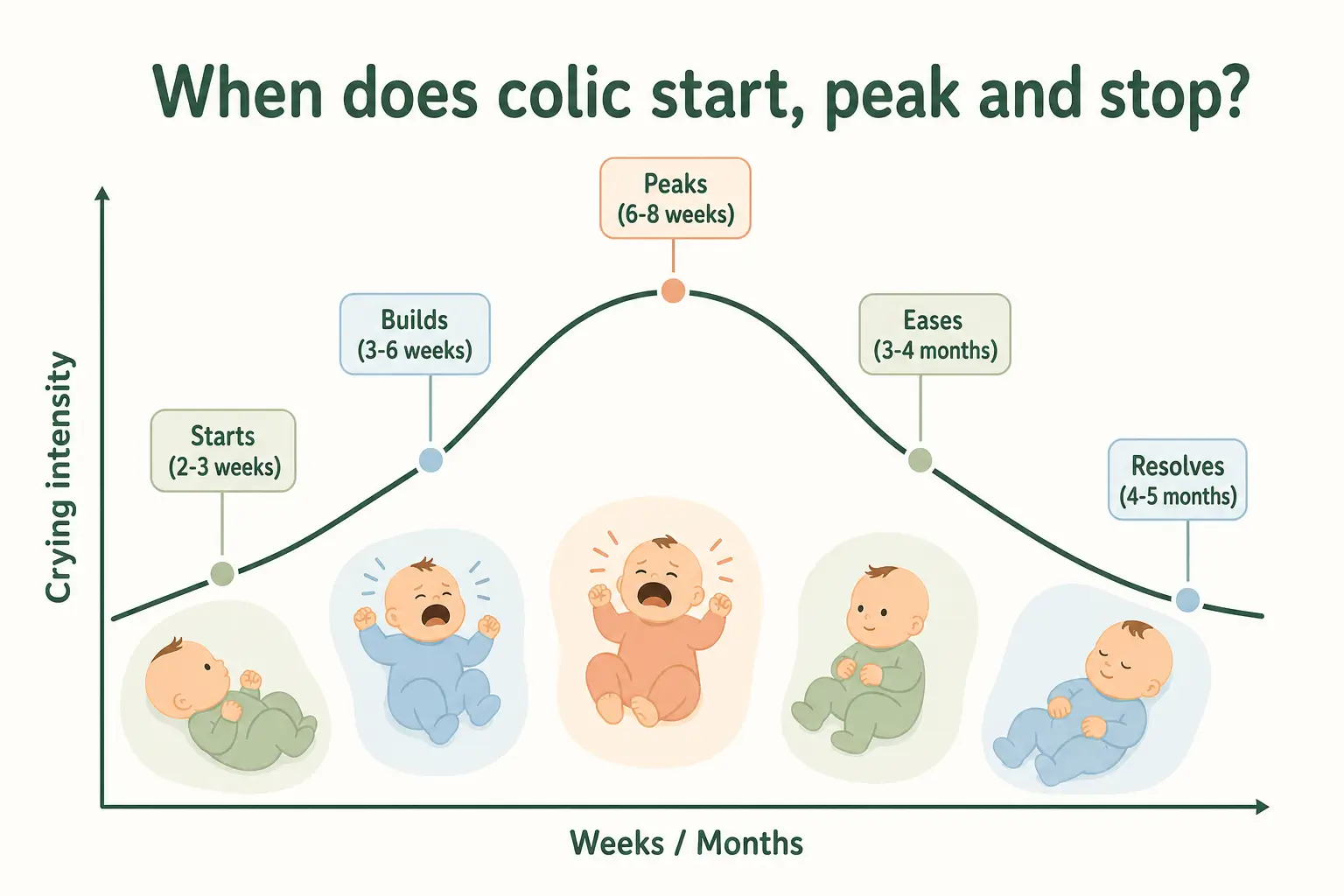
Colic typically begins in the first few weeks of life:
- It usually starts around 2-3 weeks of age
- It becomes more obvious by 4-6 weeks
- Crying peaks at 6-8 weeks for many babies
- Things gradually improve from around 3-4 months
If your baby is brand new (under 2 weeks) and crying intensely, colic is less likely. Newborns this young are often unsettled because of a hard feeding day, a growth spurt, or trapped wind – all things worth checking first.
Early signs of colic in newborns
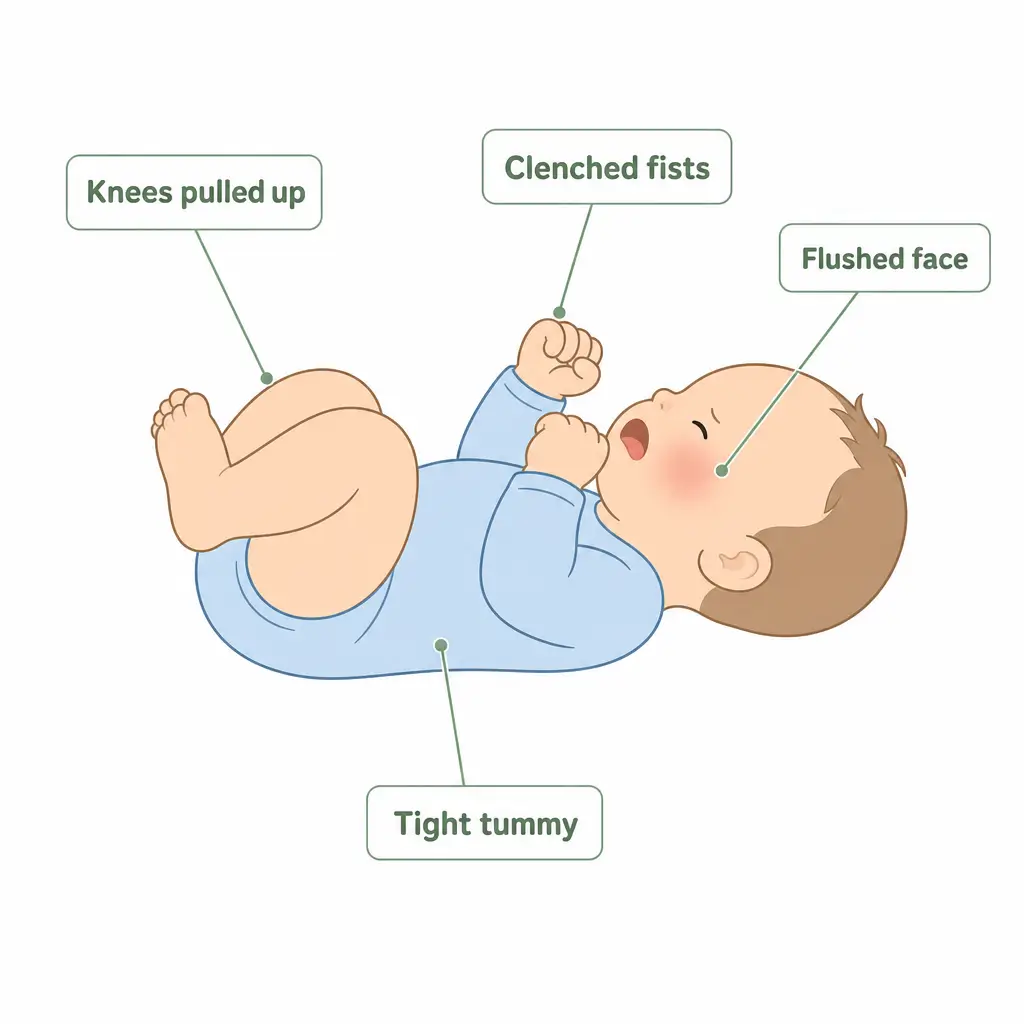
The earliest signs usually show up as a pattern building over several days:
- Long bouts of crying that don’t settle with the usual feeds, cuddles, or a clean nappy
- Crying that flares at a similar time most days, often in the late afternoon or evening
- A more urgent, higher-pitched sound than their normal cry
- A flushed, red face during a crying spell
- Knees pulled up toward the tummy
- Clenched fists and a tense, stiff little body
- A tight or hard-feeling tummy
- Restless sleep, especially after feeds
- Short, partial relief after passing wind or a good burp
You don’t need every sign on the list. If the pattern of intense, unsettled crying has been building over the last week or two, and your baby is otherwise feeding and gaining weight, colic is worth considering.
Many parents in this stage start adding a few drops of Infants’ Friend Oral Liquid into their settling routine – it contains ingredients traditionally used in Western herbal medicine for colic relief (wind/gas pain) and is suitable for use from birth.
Is it colic or normal newborn fussiness?
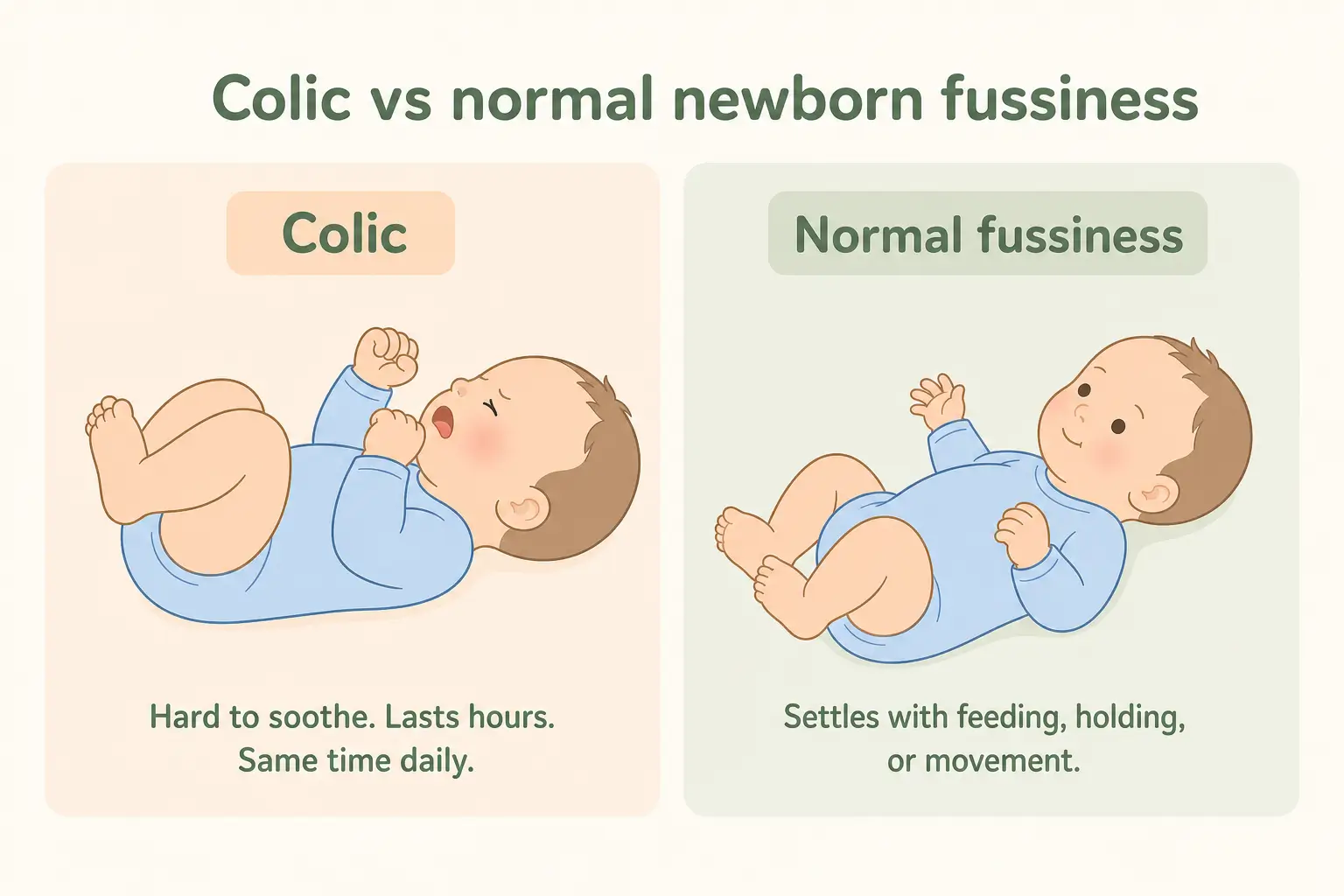
This is one of the trickiest calls to make. In the first 6 weeks, fussiness is normal. Most newborns have a stretch of unsettled time each day – they’re adjusting to life outside the womb, feeding cues come and go, and their digestive system is still maturing.
The table below is a quick way to compare what colic looks like in a newborn versus normal newborn fussiness, the Period of PURPLE Crying, reflux, and a milk-protein reaction.
| Sign | Colic in a newborn | Normal newborn fussiness | The PURPLE Crying period | Reflux | Milk-protein reaction |
|---|---|---|---|---|---|
| Duration of crying | Long bouts, often 1-3+ hours | Short bouts, 20-40 minutes | Building, sometimes hours | Variable, often around feeds | Variable, can be relentless |
| Time of day | Evening, same time most days | Scattered through the day | Often evening, but variable | Around or after feeds | Any time |
| Eases with… | Hard to ease | Feed, cuddle, change of scene | Hard to ease at peak | Upright holding after feeds | Doesn’t ease consistently |
| Tummy signs | Tight, distended; knees up | None specific | Variable | Less tummy-focused | Tummy + skin/stool signs |
| Spitting up milk | Not typical | Occasional posset | Not typical | Yes – often the main sign | Possible, often vomiting |
| Stools | Normal | Normal | Normal | Normal | Mucus or blood possible |
| Weight gain | Normal | Normal | Normal | Usually normal | Often poor |
| Rash/eczema | No | No | No | No | Often yes |
| Repeats over weeks | Yes – 3+ weeks | No – varies day to day | Yes – peaks 6-8 weeks | Yes – feeds-linked | Yes – until trigger removed |
| Resolves by 3-4 months | Yes | Settles into routine | Yes | Often improves | Once trigger removed |
If your baby’s signs cluster in the colic column, you’re likely looking at colic. If they cluster in the milk-protein reaction column, that’s a conversation for your GP. The rest tend to overlap with colic at the edges but pass on their own.
A simple decision panel for the first weeks
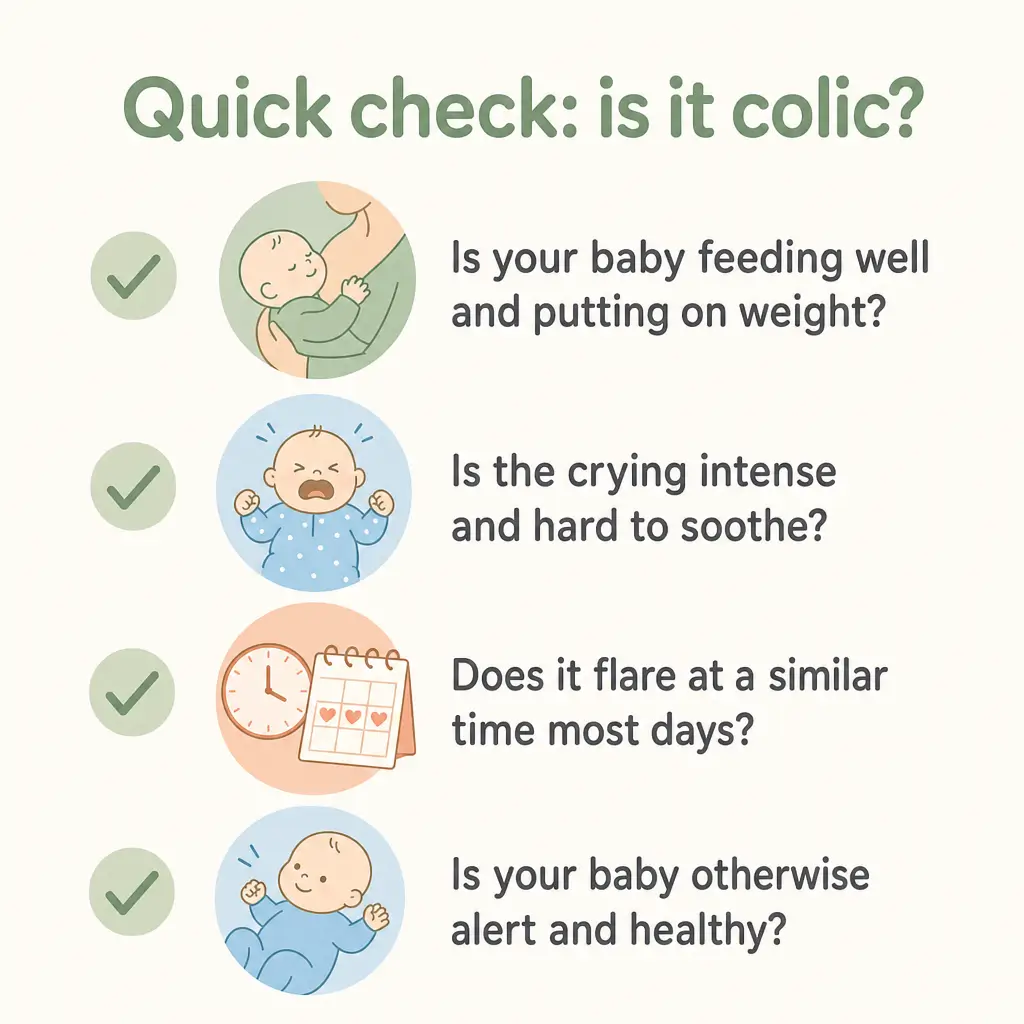
Some quick yes/no questions that can help you sort what you’re seeing:
- Is your baby under 2 weeks old? If yes, intense crying is more often linked to feeds, warmth, winding, or a growth spurt – colic is less likely. Run the basics first.
- Has the crying been getting longer and louder over the past 1-2 weeks? If yes, colic is more likely.
- Does the crying happen at roughly the same time each day (late afternoon/evening)? If yes, colic is more likely.
- Is your baby feeding well and putting on weight? If yes, that’s reassuring.
- Does anything in the “red flags” list below apply? If yes, speak to your GP today – don’t wait.
Keep a short diary of crying times for a week or so. Start time, duration, and anything that helped. Even a few days of notes makes the pattern far clearer.
Red flags – when to call your nurse or GP today
Colic in newborns is common, but newborns can become unwell more quickly than older babies. Speak to your maternal child health nurse or GP the same day if your newborn:
- Has a fever of 38°C or higher (in any baby under 3 months, this needs same-day medical advice)
- Is feeding poorly or refusing feeds
- Is vomiting forcefully or repeatedly (not just spit-ups)
- Has blood or mucus in their stool
- Isn’t gaining weight or is losing weight
- Has fewer wet nappies than usual
- Is unusually floppy, lethargic, or hard to wake
- Has a weak, high-pitched, or continuous cry that feels different to their usual
- Shows any signs of breathing difficulty
- Has a rash, especially one that doesn’t fade under pressure
Don’t second-guess yourself in the first weeks. If something doesn’t feel right, ring your nurse line or GP – that’s exactly what they’re there for.
What to do in the first weeks if you suspect colic

The early weeks of colic are often the hardest. A few things that may help:
- Gentle holding and movement – rocking, walking in a carrier, or short drives
- The colic carry – holding your baby tummy-down along your forearm gives soft pressure to the belly
- Lower the stimulation – dim lights, quiet voices, less handling between visitors in the late afternoon
- Steady, low background sound – a fan, soft white noise, or a hairdryer in the next room
- Careful winding during and after feeds. Our best ways to burp a baby walks through several positions
- Skin-to-skin time, which can help regulate your baby’s breathing and heartbeat
- A warm bath, especially in the lead-up to the evening crying window
- Ingredients traditionally used in Western herbal medicine for wind/gas relief, like those in Infants’ Friend Oral Liquid – suitable for use from birth, alcohol- and sugar-free
For a wider list of practical ideas, see our home remedies for colic and tips to soothe a crying baby.
Newborn-specific differentials
Three things in particular look like newborn colic from the outside but are worth understanding on their own terms.
The Period of PURPLE Crying

PURPLE Crying is a developmental phase of increased crying in healthy babies. It typically starts around 2 weeks, peaks around 6-8 weeks, and eases by 3-4 months – a very similar timeline to colic, which can be confusing.
The two overlap, but PURPLE crying is a description of the developmental phase, while colic is the specific pattern of long, hard-to-soothe crying bouts inside it. Many babies in the PURPLE phase don’t develop full colic. Our guide on purple crying vs colic walks through this in more detail.
Newborn reflux

Reflux is when milk moves back up from the stomach. Signs that point to reflux rather than colic:
- Spitting up milk during or soon after feeds
- Discomfort that’s worse when lying flat
- Wet burps or frequent hiccups
- Arching or stiffening during or right after a feed
Some babies have both colic and reflux. If feeds always seem to be the trigger, reflux is worth raising with your GP. Our colic vs reflux guide compares them side by side.
Cow’s milk protein intolerance

A small number of newborns react to cow’s milk protein – in formula, or passed through breastmilk. Signs include:
- A rash or eczema
- Vomiting (not just small spit-ups)
- Mucus or blood in the stools
- Poor weight gain
- Persistent, severe crying
Cow’s milk protein intolerance and colic can look similar from the outside, but the digestive and skin signs are the giveaway. Read more on cow’s milk protein intolerance and on breastfeeding diet and colic.
Looking after yourself in the first weeks
Newborn colic is hard in a particular way. You’re sleep-deprived, you’re learning to feed and care for a brand-new person, and the crying gets to you in ways you can’t always predict.
A few things worth saying clearly:
- The crying isn’t your fault. Plenty of calm, capable parents have a colicky newborn.
- If you feel overwhelmed, it’s safe to put your baby down in their cot for a few minutes while you reset.
- Share the load wherever you can – your partner, family, a friend, a postnatal doula.
- Eat, drink water, and step outside when you can.
- If you’re not coping, please talk to someone. Your maternal child health nurse, your GP, or a parenting helpline – they’ve heard it all and they’re there for exactly this.
How Infants’ Friend can help
Infants’ Friend Oral Liquid has been made in Australia since 1935. The formula contains ingredients traditionally used in Western herbal medicine for colic relief (wind/gas pain), relief from indigestion, and to relieve disturbed or restless sleep. It’s free from alcohol, sugar, and artificial flavours, sweeteners, or colours, and is suitable for use from birth.
For many Australian families, a few drops in the bottle or on a clean spoon has been part of the newborn settling routine for three generations. You’ll find Infants’ Friend at Coles, Woolworths, and Chemist Warehouse. See our where to buy page for full stockist details.
Frequently asked questions
AUST L 367810. Always read the label and follow the directions for use. If symptoms persist, talk to your health professional.