
If your baby is crying for hours and nothing seems to settle them, “colic” is probably one of the first words you’ll hear. It’s a term every parent in Australia comes across eventually – and it usually leaves them with more questions than answers.
This guide is a complete look at what colic actually means: what it is, what it looks like in a baby, why it happens, how long it lasts, and gentle ways to ride it out. By the end you’ll have a clearer picture of whether what you’re seeing is colic, and what you can do about it.
What does colic mean?
Colic is the name given to a pattern of intense, hard-to-soothe crying in an otherwise healthy, well-fed baby. It isn’t a disease and it isn’t a diagnosis – it’s a description of how the crying shows up.
A baby with colic will often cry for long stretches at a time, usually in the late afternoon or evening, with no clear trigger. They’re hard to settle even when they’re fed, changed, and held. The crying sounds more urgent and higher pitched than usual, and your baby might pull their knees up to their tummy, clench their fists, or arch their back.
Colic is common. Most parents who think their baby has colic are right. It can be exhausting, isolating, and a bit frightening if you’ve never seen it before – and importantly, it does pass.
The “Rule of 3s” – how doctors describe colic
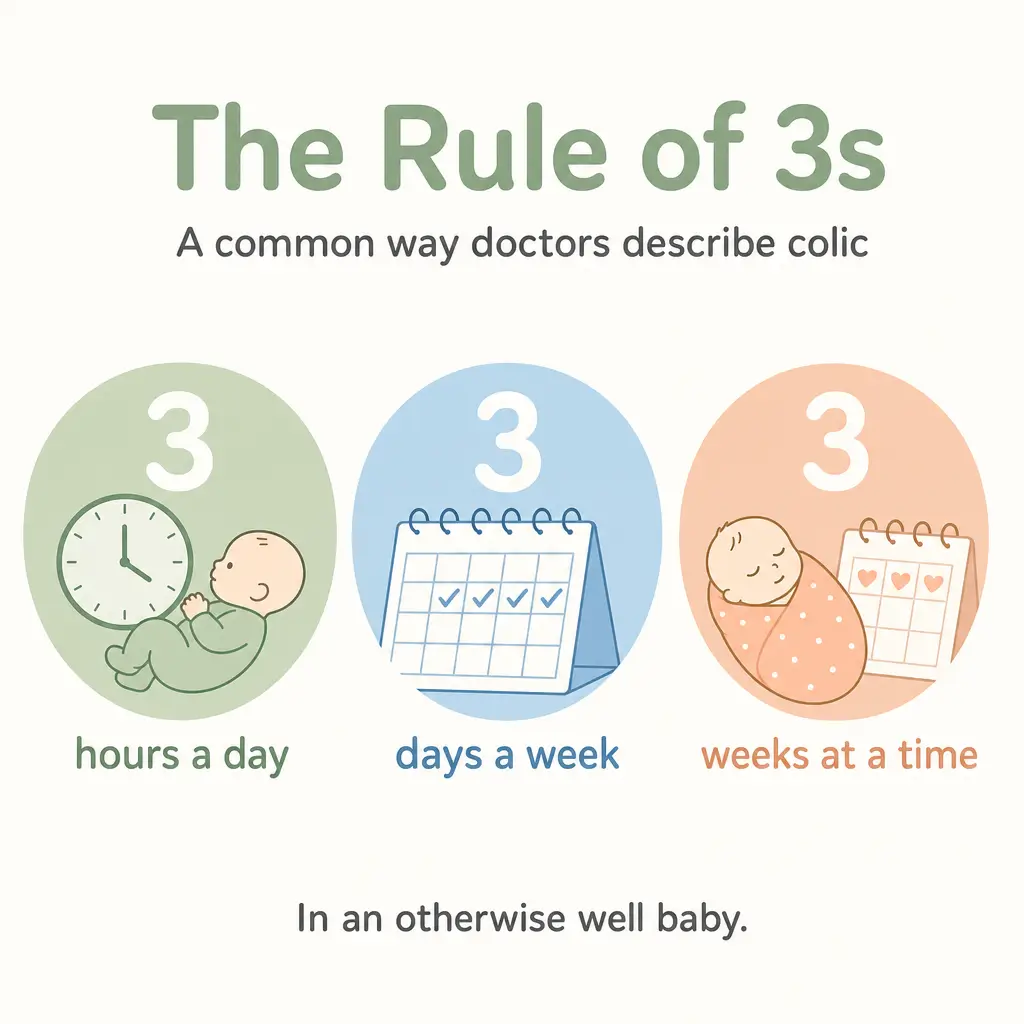 Health professionals often describe colic using what’s known as the Rule of 3s. A baby is generally considered colicky when they cry:
- For more than 3 hours a day
- On more than 3 days a week
- For more than 3 weeks at a time
- In a baby who is otherwise feeding and growing well
This isn’t a strict checklist. Plenty of colicky babies don’t tick every box. But it’s a useful way to put words around what you might be experiencing. If the crying feels relentless and follows a similar pattern most days, the Rule of 3s is the test most professionals will reach for.
What does colic look like in a baby?
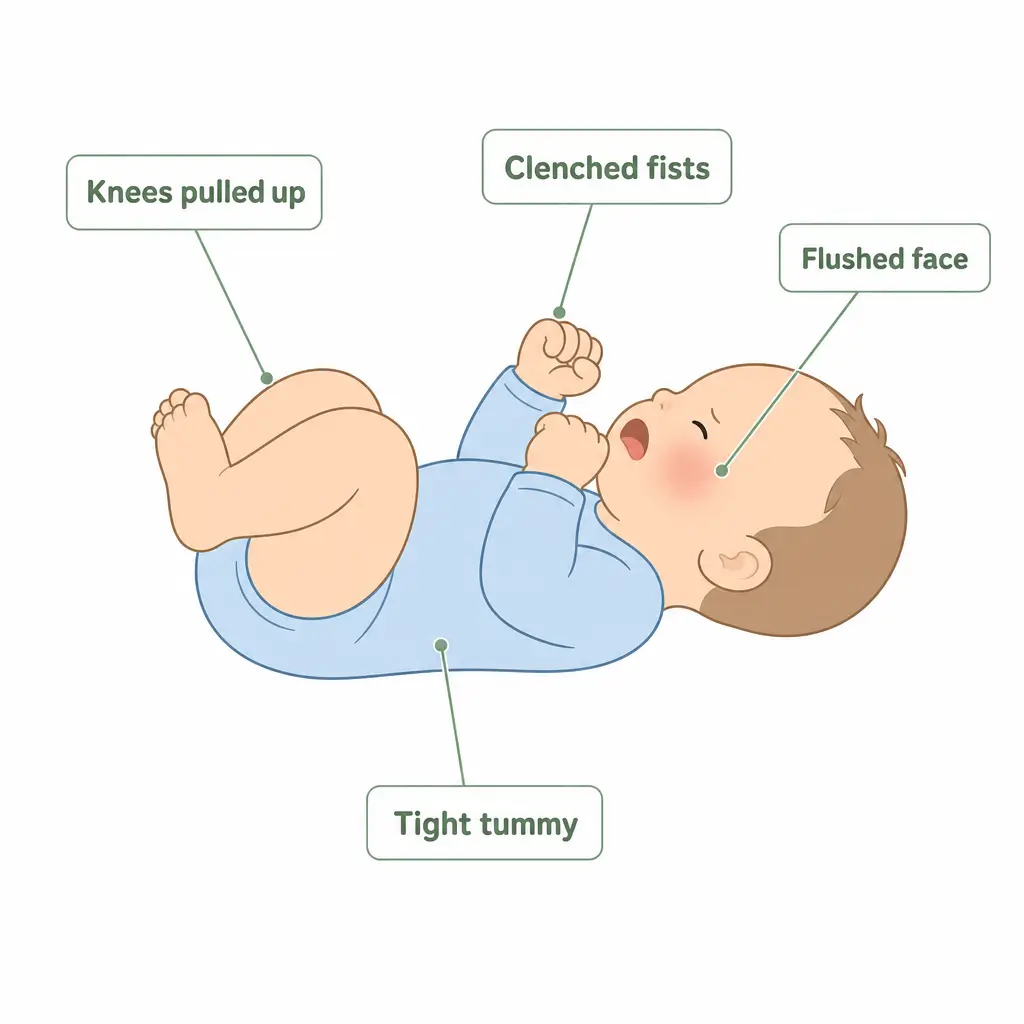 Beyond the long bouts of crying, the most common signs are:
- Evening crying that flares up at a similar time each day, often between 4pm and 9pm
- A flushed, red face during a crying episode
- Knees pulled up to the tummy or legs stretched out stiffly
- Clenched fists and a tense little body
- A tight, distended, or hard-feeling tummy
- Passing wind or short bursts of relief after a burp
- A cry that sounds more urgent, higher pitched, or “pained” than normal
- Difficulty settling after feeds
These signs come and go, and no two colicky babies look the same. For a fuller checklist of what to look out for, see our guide on colic symptoms and signs in babies.
What causes colic in babies?
The honest answer is that no one knows exactly. Decades of research haven’t pinned down a single cause, and most professionals think colic is a mix of factors that overlap differently in each baby. The most commonly discussed are below. We go through each of them in more detail in our guide to what causes colic in babies.
An immature digestive system
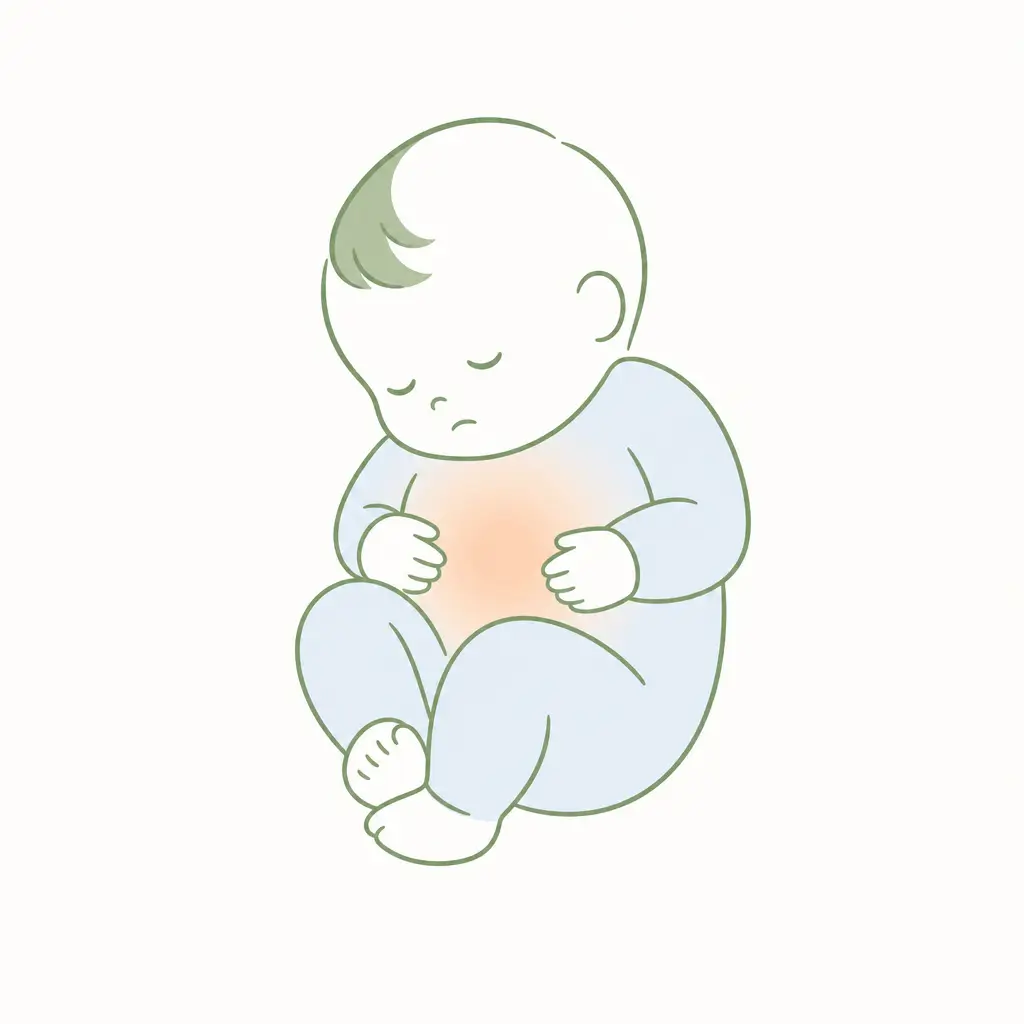 A baby’s gut is still developing in the first few months. Feeding, digesting, and passing wind are all new jobs and the system isn’t smooth yet. Many colicky babies seem windy or uncomfortable in the tummy, and short bursts of relief after a burp or a passed wind are a clue that digestion is part of the picture.
This is where the “wind and colic” framing comes from. Infants’ Friend Oral Liquid contains ingredients traditionally used in Western herbal medicine for colic relief (wind/gas pain), and for many Australian families it’s been a part of the daily routine since 1935.
Trapped wind from feeding
 Swallowed air during feeding can build up in a small tummy and cause real discomfort. Slow feeders, fast feeders, and babies who feed while crying are all prone to taking in extra air. Careful winding during and after feeds often helps, and our guide on 10 ways to relieve trapped wind walks through the most practical techniques. If you are trying to work out which one you are dealing with, see colic vs gas in babies.
Sensitivity to milk proteins
 A small number of babies react to cow’s milk protein – in formula, or passed through breastmilk. The signs are usually more than just crying: a rash or eczema, mucus or blood in the stools, frequent vomiting, or poor weight gain. If you suspect a milk reaction, it’s worth chatting to your GP or maternal child health nurse. Read more on cow’s milk protein intolerance. If you are breastfeeding, our guide on colic in breastfed babies covers what to look for.
Overstimulation and a developing nervous system
 Newborns are still learning how to regulate their bodies and emotions. By the late afternoon, the day has caught up with them – new sights, sounds, faces, feeds and naps – and some babies cry it out before they can settle. This is part of why colic so often flares in the evening.
The “second trimester outside”
 Some experts describe the first 12 weeks of life as a “fourth trimester” – your baby is still adjusting to being outside the womb, learning to feed, breathe, and sleep on their own schedule. Crying is one of the few tools they have, and a colicky baby is often a baby who finds that transition harder than most.
What’s reassuring is that colic isn’t caused by anything you’ve done wrong. Plenty of calm, capable parents end up with a colicky baby, and it doesn’t say anything about your parenting.
When does colic start, peak, and stop?
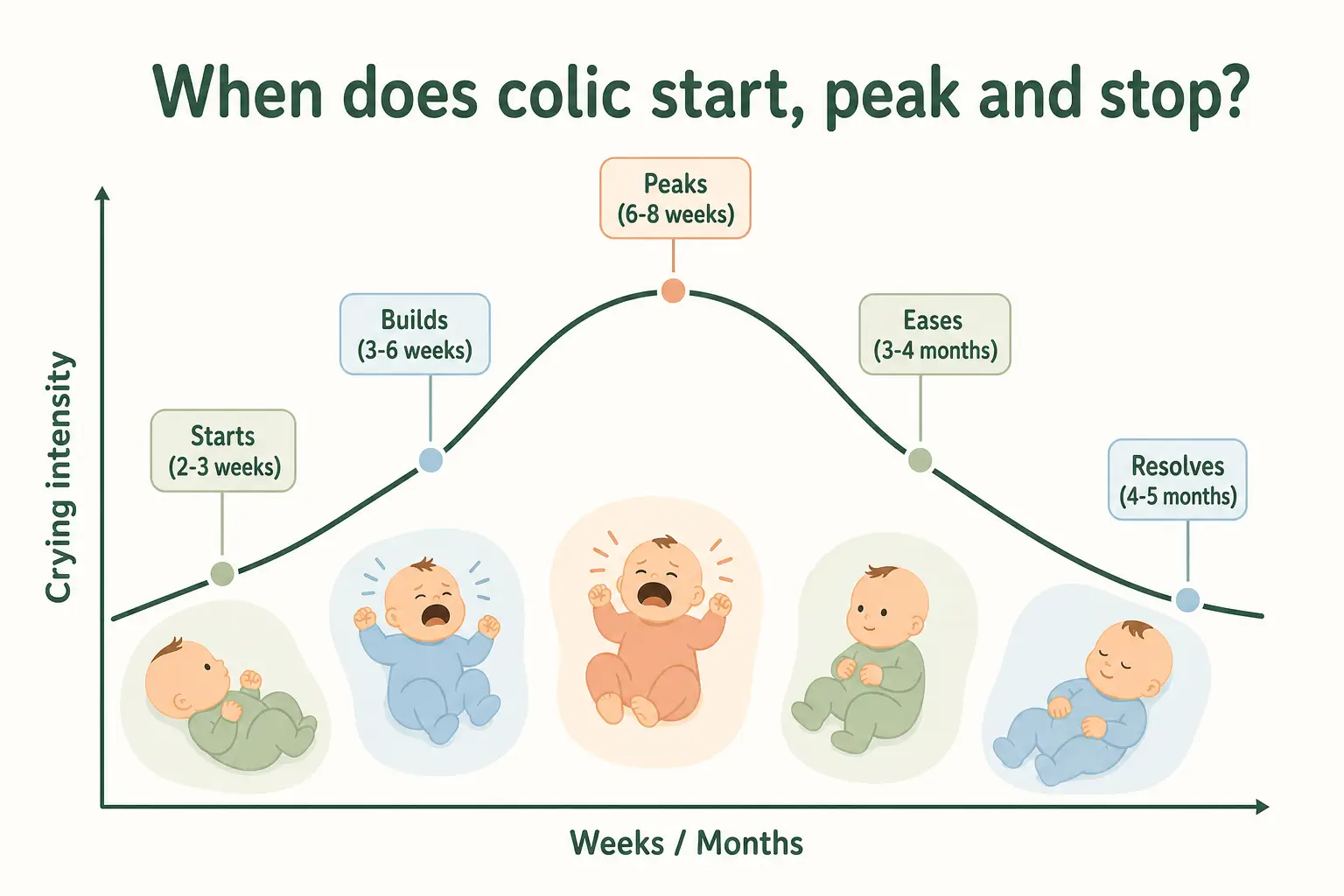 Colic follows a fairly predictable shape. The timeline below is a typical pattern, with plenty of individual variation:
| Stage | Age | What to expect |
|---|---|---|
| Starts | 2-3 weeks | Crying bouts become longer and harder to settle, often in the late afternoon or evening |
| Builds | 3-6 weeks | Pattern becomes more obvious. Many parents start to suspect colic at this point |
| Peaks | 6-8 weeks | The hardest stretch for many families. Crying can last for hours in the evening |
| Eases | 3-4 months | Bouts shorten and become less intense; the daily pattern starts to soften |
| Resolves | 4-5 months | Most babies are fully past it. Some take a little longer |
Every baby is different. Some never read the script and skip stages entirely. The key thing to hold onto is that colic has an end – it doesn’t last forever, even when it feels like it might.
Is colic a medical condition?
Colic isn’t classed as a disease and there’s no test for it. Your GP or maternal child health nurse will usually look for other causes of crying first – reflux, an ear infection, a feeding issue, milk protein sensitivity – before settling on colic.
That’s why colic is sometimes called a “diagnosis of exclusion”: when a baby is feeding, growing, and developing well but cries excessively, and no other explanation can be found, colic is the term that gets used.
In practical terms, that means colic is treated through gentle support rather than medication. The aim is to keep your baby (and you) as comfortable as possible while the phase runs its course.
How to soothe a baby with colic
 There’s no single trick that works for every baby – but there’s a long list of things worth trying. Most colicky babies have a few approaches that help on some days more than others. The trick is to build up your own toolkit.
Movement and holding
- Gentle rocking – in a chair, on the bed, or standing while you sway
- Walking with your baby in a carrier or wrap, snug against your chest
- The colic carry: holding your baby tummy-down along your forearm, with their head supported in the crook of your elbow. The light pressure on their belly helps with wind discomfort
- A short drive, if the night allows it – the steady motion and engine hum is a classic colic-soother
- A baby swing or rocker, used carefully and with supervision
Calming the senses
- Dim the lights and lower the volume of the room in the late afternoon, before the crying tends to flare
- Skin-to-skin contact, especially in the early weeks, which helps regulate breathing and heart rate
- Steady, low background sound – a fan, a white noise app, or even a hairdryer in the next room – mimics the muffled sound babies are used to from the womb
- A warm bath; the warmth and gentle support of water can be remarkably settling
Feeding and winding
- Burp during and after feeds, not just at the end. See our best ways to burp a baby
- For bottle-fed babies, try a paced feeding technique – slower, with breaks, to reduce swallowed air
- Keep your baby upright for 15-20 minutes after a feed
- If you suspect wind discomfort, ingredients traditionally used in Western herbal medicine for wind and gas pain – like those in Infants’ Friend Oral Liquid – have been part of Australian parents’ settling routines for generations
Looking after yourself
Colic is hard. The crying gets to you, the lack of sleep gets to you, and the feeling that nothing you do helps can be deeply isolating. A few rules of thumb:
- If you feel overwhelmed, it’s safe to put your baby down in their cot for a few minutes while you reset
- Share the load wherever possible – tag in your partner, a family member, or a friend
- Eat, drink water, and step outside when you can
- If you’re not coping, please talk to someone – your GP, your maternal child health nurse, or a parenting helpline
For more practical ideas, see our home remedies for colic and our tips to soothe a crying baby.
Could it be something else?
Some of the signs of colic overlap with other common things in the first few months. A quick comparison:
| If you see… | Most likely… |
|---|---|
| Spitting up milk during/after feeds, discomfort lying flat | Reflux. See colic vs reflux |
| Short fussy spells (20-40 min) that ease with feeding or a cuddle | Normal newborn fussiness or the “witching hour” |
| Trapped wind that eases once it’s passed | Wind discomfort. See relieving trapped wind |
| Rash, vomiting, blood/mucus in stools, poor weight gain | Possible cow’s milk protein intolerance – speak to your GP |
| Healthy baby with increasing crying, peaking around 6-8 weeks | The PURPLE Crying period. See purple crying vs colic |
If you’re unsure which is which, a quick chat with your GP or maternal child health nurse is the best next step. They’ve seen a lot of colicky babies and will rule out anything else worth checking.
When to seek medical advice
Colic is common, but please speak to your GP or maternal child health nurse promptly if your baby:
- Has a fever (38°C or higher in babies under 3 months)
- Is vomiting forcefully or repeatedly
- Has blood or mucus in their stool
- Isn’t gaining weight or seems to be feeding poorly
- Is unusually lethargic or hard to wake
- Has a high-pitched, weak, or continuous cry that feels different to their usual
- Has any signs of breathing difficulty
- Continues to have excessive crying past 4 months of age
Trust your instincts. If something doesn’t feel right, get your baby seen – that’s exactly what your nurse line and GP are there for.
How Infants’ Friend can help
Frequently asked questions
AUST L 367810. Always read the label and follow the directions for use. If symptoms persist, talk to your health professional.