
By the time parents go looking for colic relief, they have usually tried everything once, in one frantic evening, and concluded that nothing works. If that is where you are, take a breath. Colic has no overnight cure, but that is not the same as nothing helping.
Real colic relief is a toolkit, not a single fix: reduce the wind that fuels the discomfort, adjust the feeds that create the wind, settle the crying itself, and give the whole thing time to pass. This page walks through that toolkit in a sensible order, so you can work through it methodically instead of at 2am in alphabetical order.
What Colic Relief Really Means
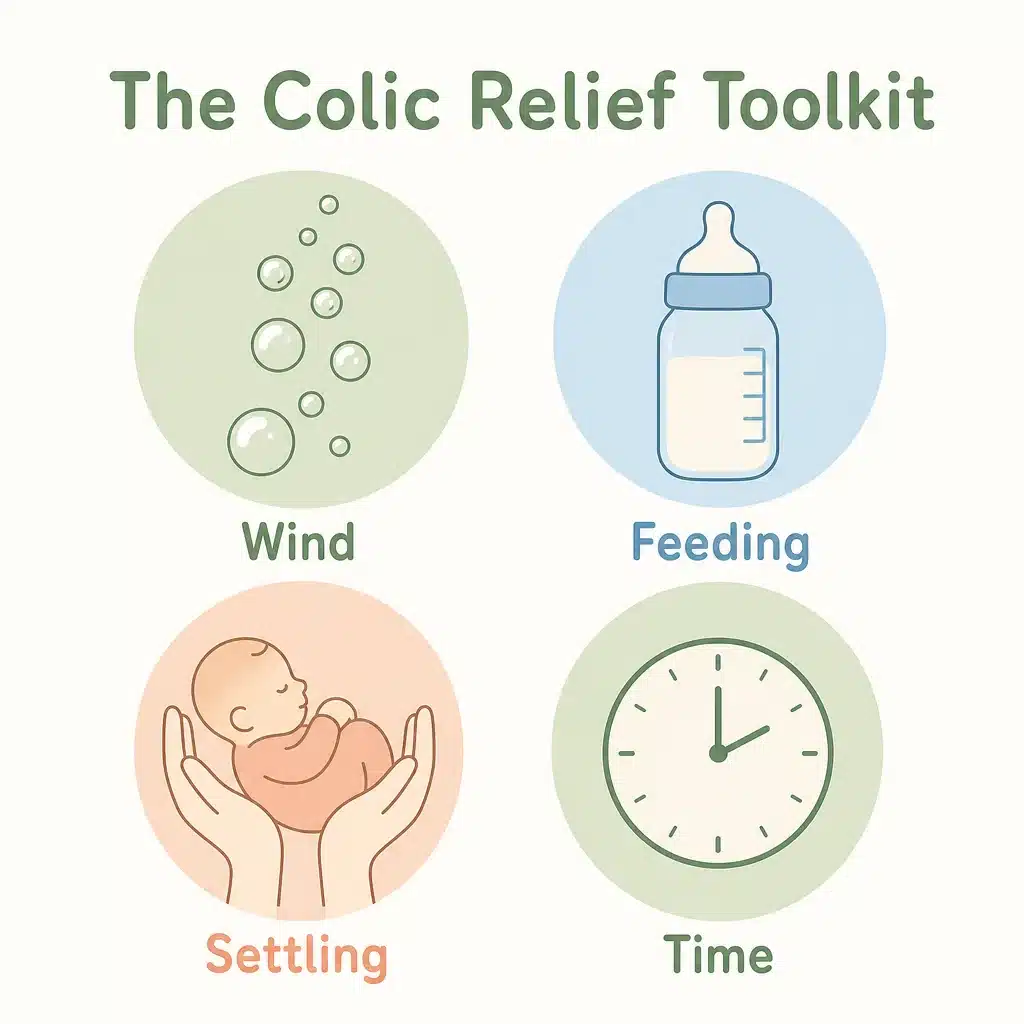
An honest starting point: colic is something babies grow out of, not something you can cure from the outside. It typically starts around two to three weeks, peaks near six weeks and resolves by three to four months, as your baby’s digestion and nervous system mature.
So the goal of colic relief is practical: make your baby more comfortable, make episodes shorter and less frequent, and make the whole season more survivable for everyone in the house. Measured against that goal, quite a lot actually helps. Measured against “make it stop entirely, tonight”, everything fails, which is exactly how parents end up feeling defeated by week five.
One mindset shift makes the biggest difference: work on colic through the whole day, not just during the crying. Most of the levers below are pulled at feed time and in the calm hours, long before the evening storm rolls in.
Start With Wind: The Most Fixable Piece

Not all colicky crying is wind, but wind is the piece you can genuinely do something about, today. Babies swallow air with every feed and every cry, and an immature gut struggles to move it along. Trapped wind hurts, and a baby crying from wind swallows more air, which is the whole miserable cycle in one sentence. If you are not sure which one you are dealing with, our guide to colic vs gas breaks down the differences.
Burp Well, and Burp Often
Burping is the least glamorous and most reliable wind tool. A few upgrades on the standard pat:
- Burp partway through each feed, not just at the end
- Try more than one position: over the shoulder, sitting upright on your lap with chin supported, or lying face-down across your knees
- Give it a few minutes. Some burps need a slow walk and a rub, not thirty seconds
Our guide to the best ways to burp a baby covers each position step by step.
Positions That Help Wind Move
Between feeds, position is your friend. Holding your baby upright after feeds gives air a straight path up. Tummy-down positions, like the classic colic carry along your forearm, or supervised tummy time when your baby is awake, put gentle pressure on the tummy that helps wind shift. Our 10 ways to relieve trapped wind guide has the full set.
Tummy Massage and Bicycle Legs

With your baby on their back, gently cycle their legs towards their tummy, then try slow clockwise circles around the belly button with warm hands. Both techniques encourage trapped wind through and along. They work best in a calm window, after a bath or nappy change, rather than mid-meltdown.
Feeding Adjustments Worth Trying

Feeds are where most swallowed air comes from, which makes them the best place to prevent colic discomfort rather than just respond to it.
Slow Things Down
Feed before your baby is frantic, keep them fairly upright during the feed, and let them pause. Gulped, frantic feeds carry more air down with the milk. After the feed, twenty to thirty minutes upright before lying flat gives everything a chance to settle.
Check the Latch or the Teat
A shallow latch at the breast, or a teat that flows too fast or too slow from the bottle, all increase air swallowing. If bottle feeding, keep the bottle angled so the teat stays full of milk, and check the teat size suits your baby’s age and pace.
If You Are Breastfeeding
Colic happens in breastfed and bottle-fed babies alike, so do not let anyone tell you your milk is the problem. That said, a couple of threads are worth reading if you are breastfeeding a colicky baby: our guides to colic in breastfed babies and breastfeeding diet and colic cover what is worth looking at and what is old wives’ territory.
Could It Be a Milk Sensitivity?
For a small number of babies, colic-like crying traces back to a sensitivity such as cow’s milk protein intolerance. The clues look different from plain colic: skin rashes, vomiting, diarrhoea or mucus in the poo, poor weight gain, or symptoms spread across the whole day rather than clustered in the evening. If that list sounds familiar, read our guide to cow’s milk protein intolerance and raise it with your GP before changing anyone’s diet. Formula-hopping or cutting foods on a guess rarely helps and makes it harder to see what is actually going on.
Settling Techniques for the Crying Itself

When an episode is underway, comfort becomes the job. The techniques that earn their keep, night after night:
- Rhythmic movement: slow walking, rocking, a carrier or sling
- The colic carry: baby tummy-down along your forearm, gentle pressure on their tummy
- Steady sound: shushing, white noise, the rangehood, a low hum
- Warmth: a warm bath, skin-to-skin on your chest
- Less, not more: dim lights, low noise, slow handling for an overstimulated baby
We have a full walkthrough in our guide to how to soothe a colicky baby, including what to do when nothing is landing and how to tag-team the evenings without both parents burning out.
Natural and Herbal Colic Relief

Herbal remedies for infant colic and wind have been part of Australian family life for generations, typically built on herbs with a long history of traditional use for digestive comfort.
Infants’ Friend Colic & Wind is a blend of chamomile, lemon balm and dill seed oil. These herbs are traditionally used in Western herbal medicine to relieve colic symptoms, wind and gas pain, and mild indigestion in infants. It is alcohol-free, suitable from birth when used as directed, and has been made in Australia since 1935, which is why your parents and grandparents likely know the name.
It is given by mouth before feeds, so it slots neatly into the daily routine ahead of the evening window. You can read how it works and how to use it, and find it at Coles, Woolworths and Chemist Warehouse via our where to buy page. Always read the label and follow the directions for use. Our home remedies for colic guide rounds up the other traditional approaches families lean on.
Give Each Change a Fair Go

The fastest way to conclude nothing works is to try seven things in one night. The kinder, smarter approach:
- Change one thing at a time
- Give it three or four days before judging it, since colicky evenings vary on their own
- Keep rough notes: when the crying starts, how long it lasts, what preceded it
- Remember the natural curve. Colic worsens to a peak around six weeks regardless of what you do, so judge a change against the pattern, not against a single bad night
Notes also turn a vague, exhausted “it’s just constant” into a clear picture you can share with your child health nurse, and they will often reveal that things are improving before your morale catches up.
When to Bring In Your GP or Child Health Nurse
Bring in your GP or maternal child health nurse if your baby has a fever, vomiting, diarrhoea, poor weight gain, fewer wet nappies, blood or mucus in the poo, or a cry that sounds weak, high-pitched or simply wrong to you. Constant crying spread across the whole day, rather than evening clusters, also deserves a look, as does crying that begins after three months or comes with feed refusal.
None of this is alarmist. Most of these visits end in reassurance, and reassurance is worth having. Take your notes along, and if you are unsure where your baby sits, our colic quiz can help you frame the conversation.
Infants’ Friend Colic & Wind (AUST L 367810) contains ingredients traditionally used in Western herbal medicine for colic relief (wind/gas pain). Available Australia-wide since 1935.
Frequently Asked Questions
AUST L 367810. Always read the label and follow the directions for use. If symptoms persist, talk to your health professional.