
The quick difference: gas is trapped air in your baby’s tummy that you can usually help along with a burp or a knee-to-tummy stretch, and it settles once the wind passes. Colic is a pattern of long, hard-to-soothe crying that keeps going even after the wind is out. Most babies get a bit of both.
At a glance: gas comes and goes through the day and eases after a burp. Colic runs in long stretches, often in the evening, and peaks around 6 to 8 weeks before settling by 3 to 4 months.
A gassy, unsettled baby and a colicky, crying baby can look almost the same from where you’re standing at 6pm with a screaming newborn. Both leave you rocking, bouncing and wondering what you’ve missed. So when parents ask about colic vs gas, they’re really asking a practical question: is my baby just windy, or is something more going on, and does it change what I should do?
The short answer is that gas and colic are related but not the same. This guide explains what each one is, how to tell them apart, whether wind can cause colic, and the gentle, low-risk things you can try tonight.
What is gas (wind) in babies?
Gas, or wind, is simply air in your baby’s tummy and gut. Every baby swallows some air when they feed, cry or suck, and their digestive system is still learning how to move milk and wind through smoothly. That’s completely normal.
A gassy baby often shows fairly specific signs:
- a tight or bloated-looking tummy
- lots of burps, or trouble bringing a burp up
- passing wind frequently
- pulling knees up and going red in the face, then settling once the wind passes
- squirming and grunting, especially during or after feeds
The key thing with wind is that it usually comes and goes. Your baby is uncomfortable, you help them burp or pass wind, and there’s often some relief afterwards.
What is colic?
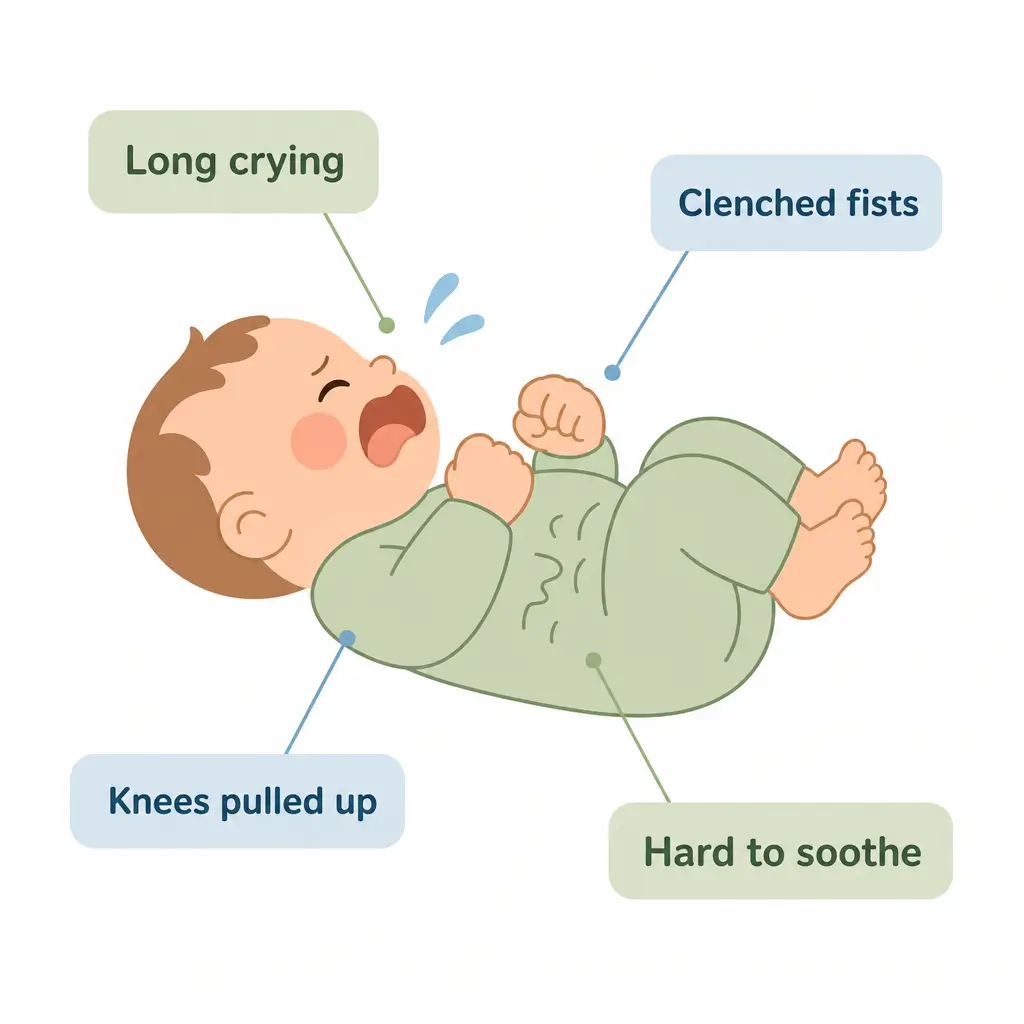
Colic is a term for a pattern of intense, hard-to-soothe crying in a baby who is otherwise healthy and feeding well. It isn’t a disease or a diagnosis. It’s a description of how the crying behaves: frequent, prolonged, and difficult to settle even when you’ve tried the usual things.
Colic often:
- starts in the first few weeks
- peaks for many babies around 6 to 8 weeks
- eases by around 3 to 4 months, though the timeline varies
- clusters in the late afternoon and evening
A colicky baby may look windy and uncomfortable too, with clenched fists, a tense tummy and knees drawn up. The difference is that with colic, the crying often keeps going even after you’ve burped, fed and cuddled. If you’d like a fuller checklist, see signs your baby might have colic.
Colic vs gas: the key difference
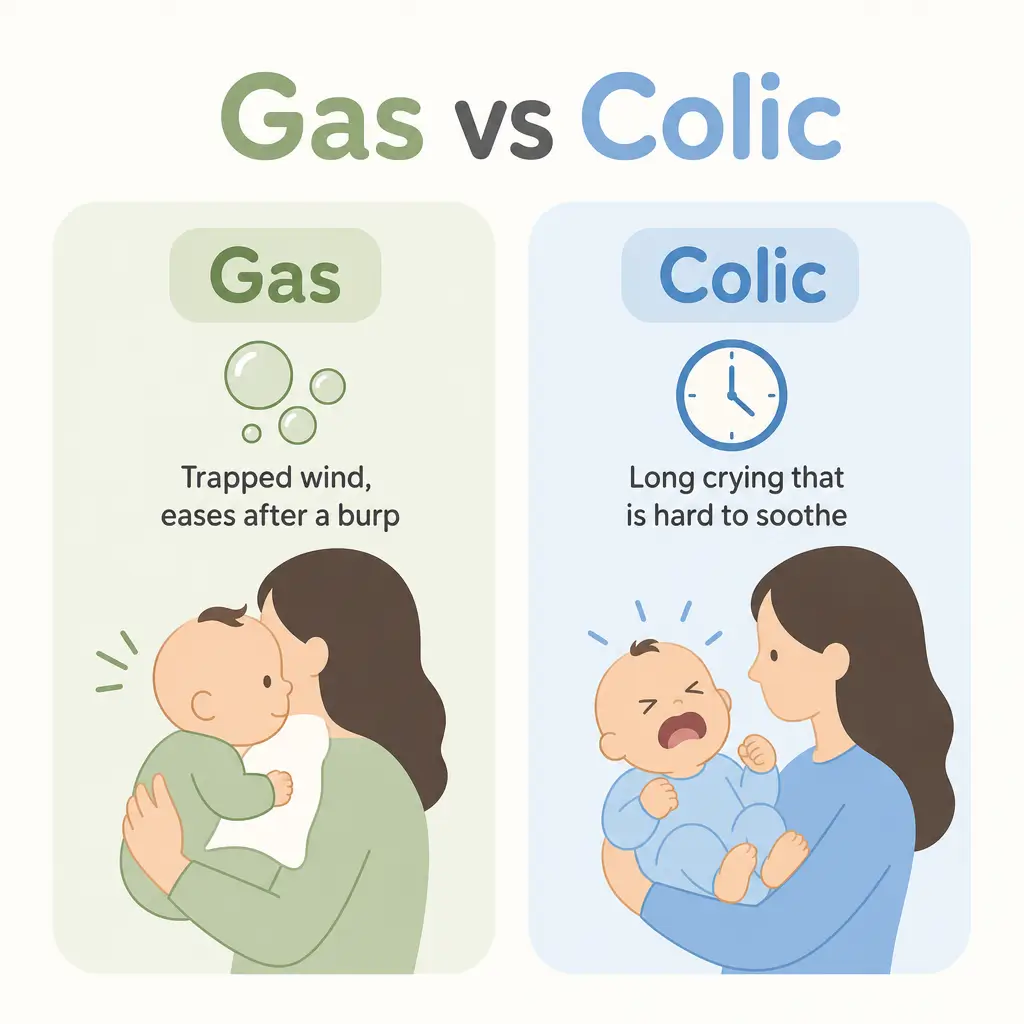
The simplest way to hold the difference in your head: gas is a physical thing you can often relieve, while colic is a crying pattern that doesn’t always have an obvious cause or an obvious fix. Wind tends to ease once it passes. Colic tends to run its course over weeks.
| Feature | Gas (wind) | Colic |
|---|---|---|
| What it is | Air trapped in the tummy or gut | A pattern of excessive, hard-to-soothe crying |
| Main sign | Bloating, burping, passing wind | Long crying stretches, often in the evening |
| Relief | Often settles after a burp or passing wind | Crying may continue even after burping and feeding |
| Timing | Any time, often around feeds | Frequently late afternoon or evening |
| Duration | Comes and goes through the day | A phase that peaks around 6 to 8 weeks, then eases |
| Baby’s mood between episodes | Usually content once the wind passes | Can be unsettled for long stretches |
Signs it’s mostly gas or wind
If your baby’s discomfort is mainly wind, you’ll often notice:
- a hard, swollen tummy that softens after a good burp
- frequent farting, sometimes with visible relief afterwards
- grunting and straining, then calming down
- discomfort that’s closely tied to feeds
- settling reasonably well once the wind is out
For hands-on help, see relieving trapped wind and the best ways to burp a baby.
Signs it’s more likely colic
Colic tends to look like this:
- long crying bouts, often at the same time each day
- crying that’s hard to soothe even after feeding, burping and cuddles
- a baby who seems well otherwise, feeding and growing normally
- a pattern that has lasted for weeks, not just a windy afternoon
- evenings that are consistently the hardest part of the day
If that sounds more like your baby, a comparison you may also find useful is colic vs reflux, since reflux is another common reason for post-feed crying.
Can gas cause colic, or make it worse?
This is where colic and gas blur together. Wind doesn’t cause colic, but the two often travel together and can feed off each other. A baby who is crying hard swallows more air, which builds more wind, which adds more discomfort, which can fuel more crying. Breaking that loop with steady burping and calm settling is worth doing even if the underlying pattern is colic.
So it’s normal for a colicky baby to also be windy, and normal for a windy evening to tip into a longer crying spell. You don’t have to pick one label. You can simply respond to what your baby is showing you: help the wind out, then focus on calm.
If the crying is starting to feel like more than wind, our 2-minute colic quiz can help you make sense of the pattern.
How to relieve baby gas and wind

If you have a gassy baby and you’re after quick, practical baby gas relief, the good news is that most of it comes down to simple, low-risk moves. You don’t need special equipment. Pick two or three of these and give them a fair go for a day or two.
Burp during and after feeds
Air swallowed during a feed is the most common source of wind.
- pause partway through the feed for a burp
- burp again at the end
- try a few positions: over the shoulder, sitting upright on your lap, or tummy-down across your knees
Tummy massage and bicycle legs
Gentle movement can help wind move through.
- lay baby on their back and massage the tummy in slow, clockwise circles with warm hands
- cycle their legs gently, like slow pedalling
- bring their knees softly toward the tummy and release (never forced)
Slow down feeds
Fast feeding means more swallowed air.
- if bottle feeding, try paced feeding and check the teat isn’t flowing too fast
- if breastfeeding and you have a strong let-down, short pauses and a more upright position can help
- keep feeds calm, with breaks to breathe and swallow
Keep baby upright after feeds
A calm, upright cuddle for 20 to 30 minutes after a feed gives wind an easier path up and milk an easier path down while your baby’s digestion matures.
Calm the evening
If your baby is windier and fussier in the evenings, lower the stimulation: dim the lights, keep things quiet, use steady white noise, and settle into a simple feed, burp, cuddle rhythm.
When to see a GP
Wind and colic are common and usually settle with time, but book a check with your GP or child health nurse if your baby has any of these:
- fever
- green (bilious) vomiting or repeated projectile vomiting
- blood or mucus in stools
- fewer wet nappies than expected, or signs of dehydration
- poor feeding or poor weight gain
- a tummy that stays hard and swollen and doesn’t settle
- unusual lethargy, or a baby who simply seems unwell
You know your baby best. If your instincts say something isn’t right, it’s always okay to get them checked.
Gentle support from Infants’ Friend

Some families use Infants’ Friend Colic & Wind, with chamomile, lemon balm and dill seed oil, which are all ingredients traditionally used in Western herbal medicine to help relieve wind or gas pain, mild indigestion and disturbed or restless sleep in babies. It is alcohol-free, sugar-free, and suitable from birth when used as directed.
Infants’ Friend Colic & Wind (AUST L 367810) contains ingredients traditionally used in Western herbal medicine for colic relief (wind and gas pain). Available Australia-wide since 1935.
Frequently Asked Questions
Final thoughts
Trying to sort colic from gas is really about reading your baby, not landing on a perfect label. Wind is a physical thing you can often relieve; colic is a crying pattern that runs its course. Most babies are a bit of both at some point, and most grow out of it. Steady burping, calm feeds, gentle tummy work and quieter evenings will help whichever one you’re dealing with.
AUST L 367810. Always read the label and follow the directions for use. If symptoms persist, talk to your health professional.