
When your baby cries for long stretches and seems uncomfortable no matter what you try, it’s natural to wonder whether it’s colic. The tricky part is that there’s no single sign that points to colic. It’s a pattern—a combination of physical cues and crying behaviour that builds up over days and weeks.
This guide walks through the most common symptoms and signs of colic in babies, what they tend to look like in practice, how to tell colic apart from other causes of unsettled crying, and when it’s worth speaking to your GP.
What is colic?
Colic is a description of a pattern: long bouts of intense, hard-to-soothe crying in a baby who is otherwise feeding and growing well. It isn’t a disease, and it doesn’t have a single cause. For a deeper definitional read, see our guide on what is colic in babies.
The most widely used clinical description is the “Rule of 3s”: crying for more than 3 hours a day, on more than 3 days a week, for more than 3 weeks. Many colicky babies don’t tick every box, but the pattern is what matters.
At-a-glance: the most common signs of colic
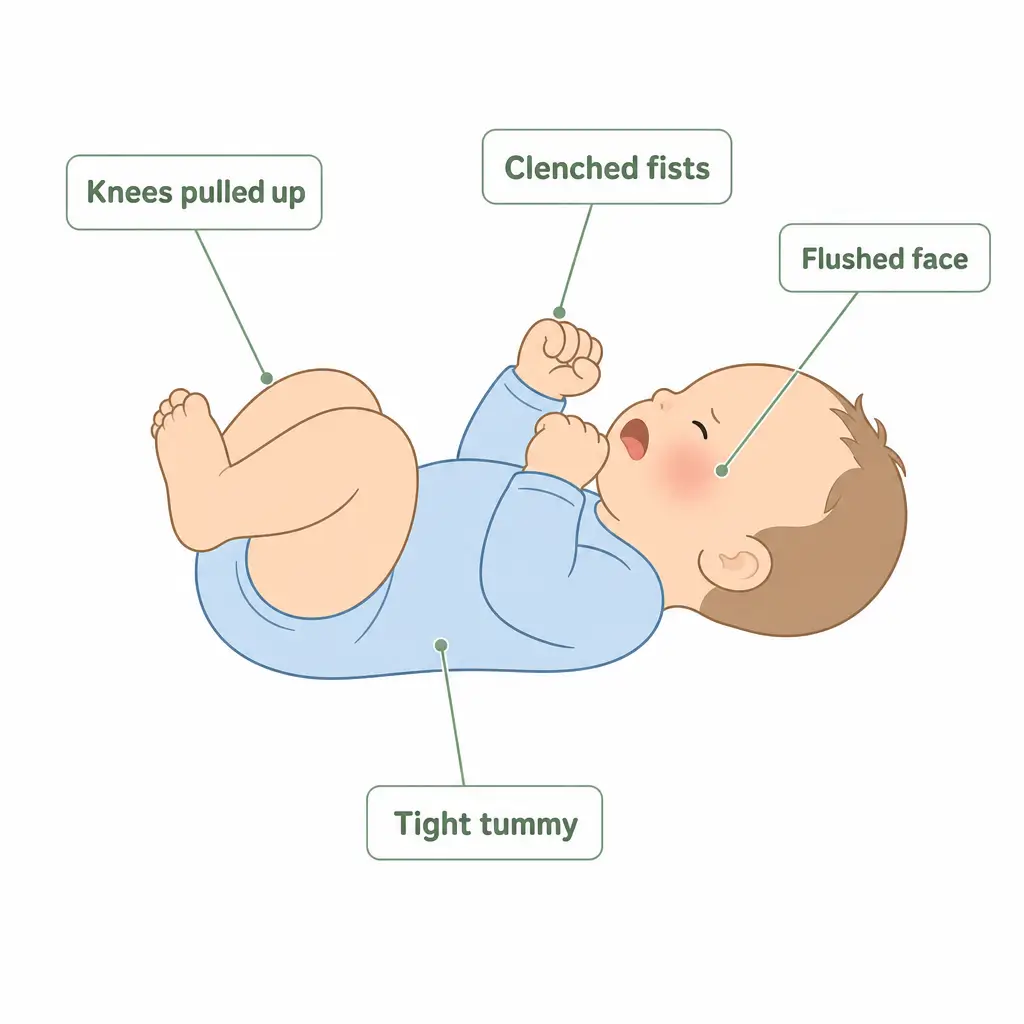
Most colicky babies show a mix of the following:
- Intense, hard-to-soothe crying that lasts for hours
- Crying that flares up at a similar time each day, often the late afternoon or evening
- A flushed or red face during a crying spell
- A tight, distended, or hard-feeling tummy
- Knees pulled up toward the tummy
- Clenched fists and stiff, tense limbs
- Arching of the back
- Passing wind or a small burp that gives short, partial relief
- Crying that doesn’t ease with feeding, rocking, or cuddling
- Disturbed or restless sleep, especially after feeds
If most of these sound familiar, you may well be looking at colic—especially if the pattern has lasted a few weeks and your baby is otherwise feeding and gaining weight as expected.
Physical signs of colic in babies
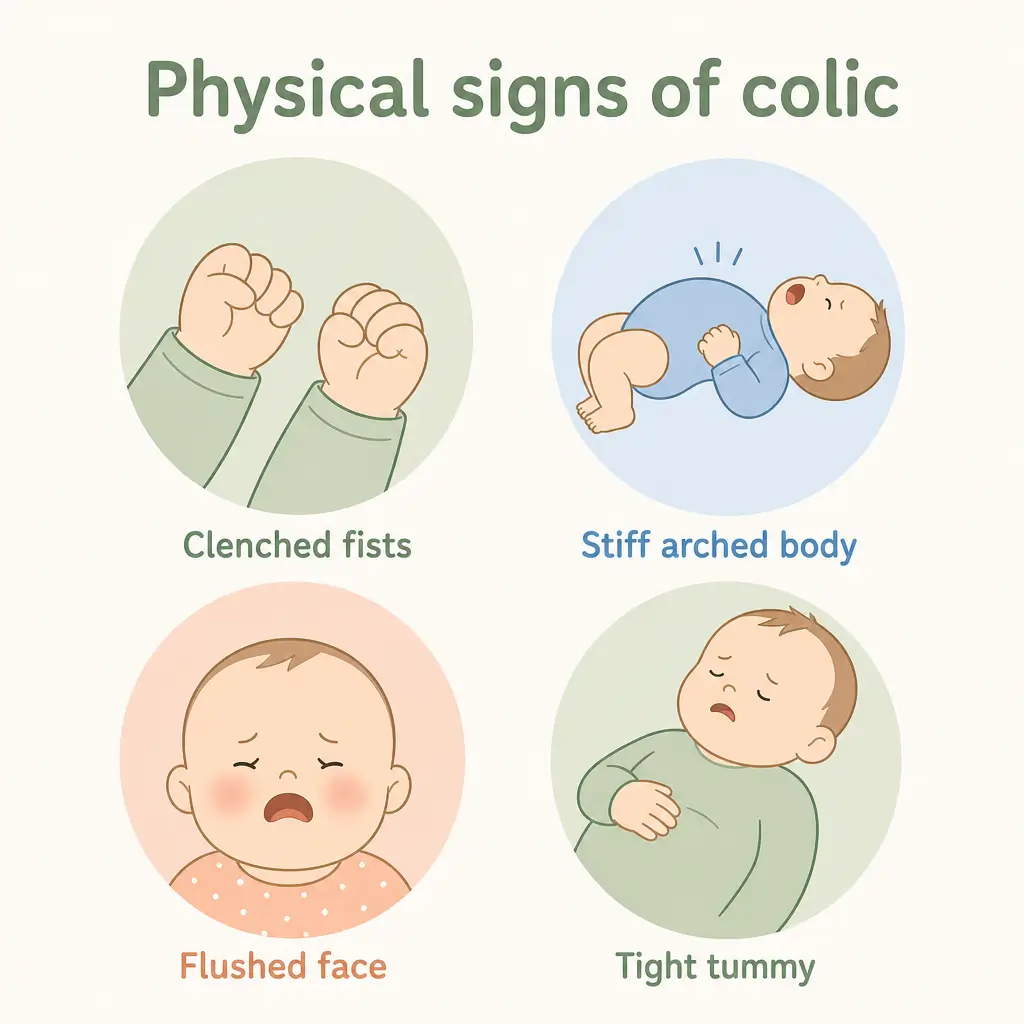
Colic shows up in the body as well as in the crying. The physical cues are often what helps parents and health professionals tell colic apart from general fussiness.
- A tense or distended tummy. Many colicky babies have a tummy that feels firmer than usual, sometimes with audible gurgling.
- Knees drawn up to the chest. This is the classic “colic curl” position and is thought to be a response to abdominal discomfort.
- Clenched fists. Hands often look tightly balled up during a colic episode.
- Stiffening of the body. Some babies arch their back or stretch their legs out rigidly.
- A red, flushed face. The effort and stress of crying often shows in the colour of your baby’s skin.
- Passing wind. Many colicky babies pass wind during or right after a crying spell, and may seem briefly more settled afterwards.
That last cue is one of the strongest signals that wind and gas are part of the picture. Infants’ Friend Oral Liquid contains ingredients traditionally used in Western herbal medicine for colic relief (wind/gas pain), and for many Australian parents it’s a routine part of the evening settling cuddle. We’ll come back to it lower down.
Behavioural signs of colic in babies

The behavioural pattern matters as much as the physical signs:
- Crying that builds rather than starts suddenly. Many babies have a “warm-up” of fussing before a longer bout begins.
- A repeated time of day. Most colic spells fall between 4pm and 9pm.
- No response to the usual fixes. A feed, a clean nappy, a cuddle, or a change of scene won’t shorten it.
- A different sound to the cry. Parents often describe it as more urgent, higher pitched, or “pained” compared with their baby’s normal cry.
- Hard-to-settle behaviour after feeds. Wriggling, grunting, and short bursts of sleep that don’t last.
- Catnapping in the late afternoon. Especially in the lead-up to the evening crying window.
Colic doesn’t usually affect feeding or weight gain. If your baby is feeding well, putting on weight, and developing normally, that’s a reassuring sign—even when the crying feels overwhelming.
When do colic symptoms appear and how long do they last?
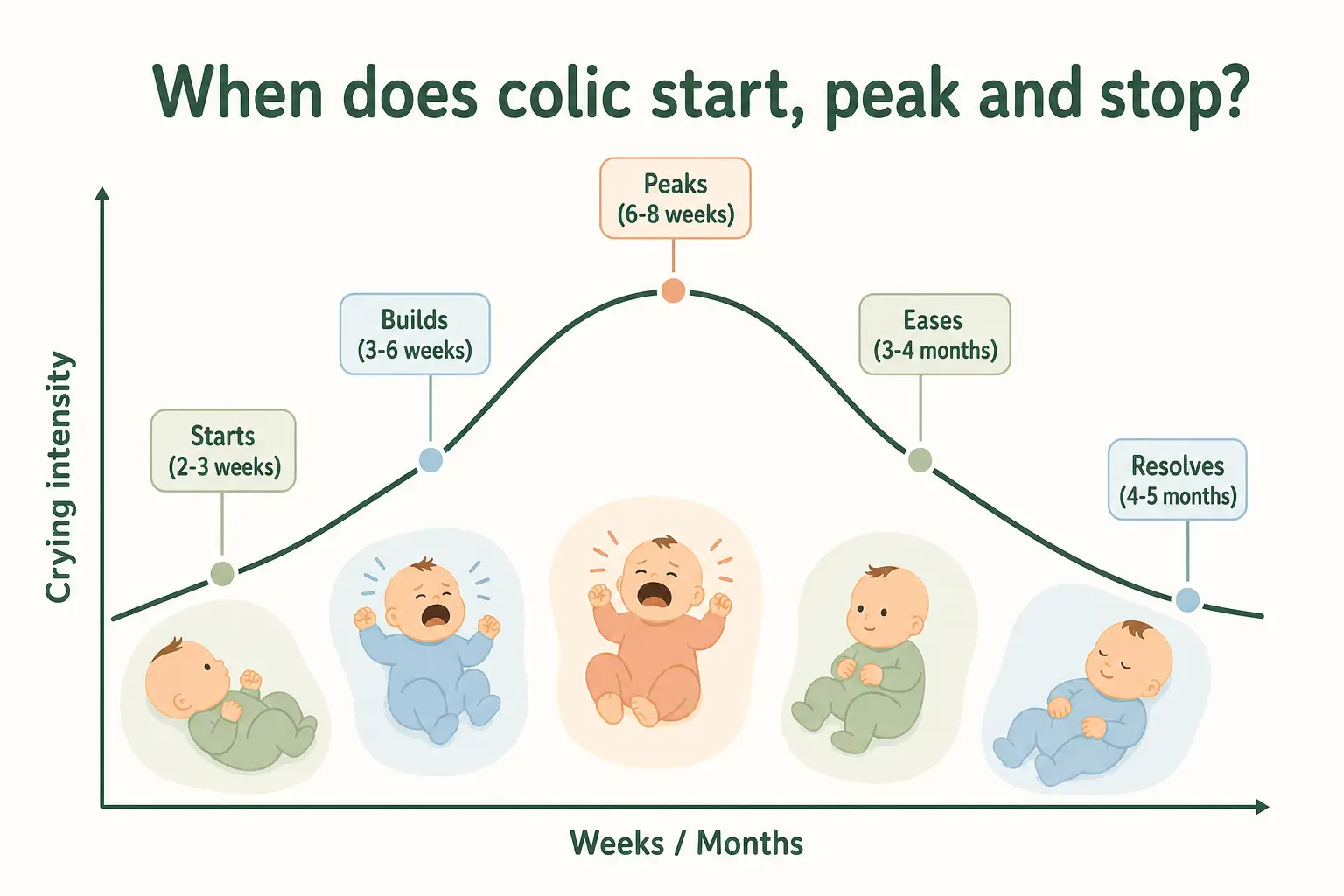
The timeline follows a fairly predictable shape:
| Stage | Age | What you might notice |
|---|---|---|
| Starts | 2–3 weeks | Crying bouts get longer; harder to settle in the evening |
| Builds | 3–6 weeks | A clear evening pattern is forming |
| Peaks | 6–8 weeks | The hardest stretch—crying can go for hours |
| Eases | 3–4 months | Bouts shorten; daytime is calmer |
| Resolves | 4–5 months | Most babies are completely past it |
It can help to keep a simple diary of your baby’s crying times for a week or so. A clear evening pattern, with calm stretches during the day, is one of the strongest clues that you’re dealing with colic.
Colic vs other causes of unsettled crying
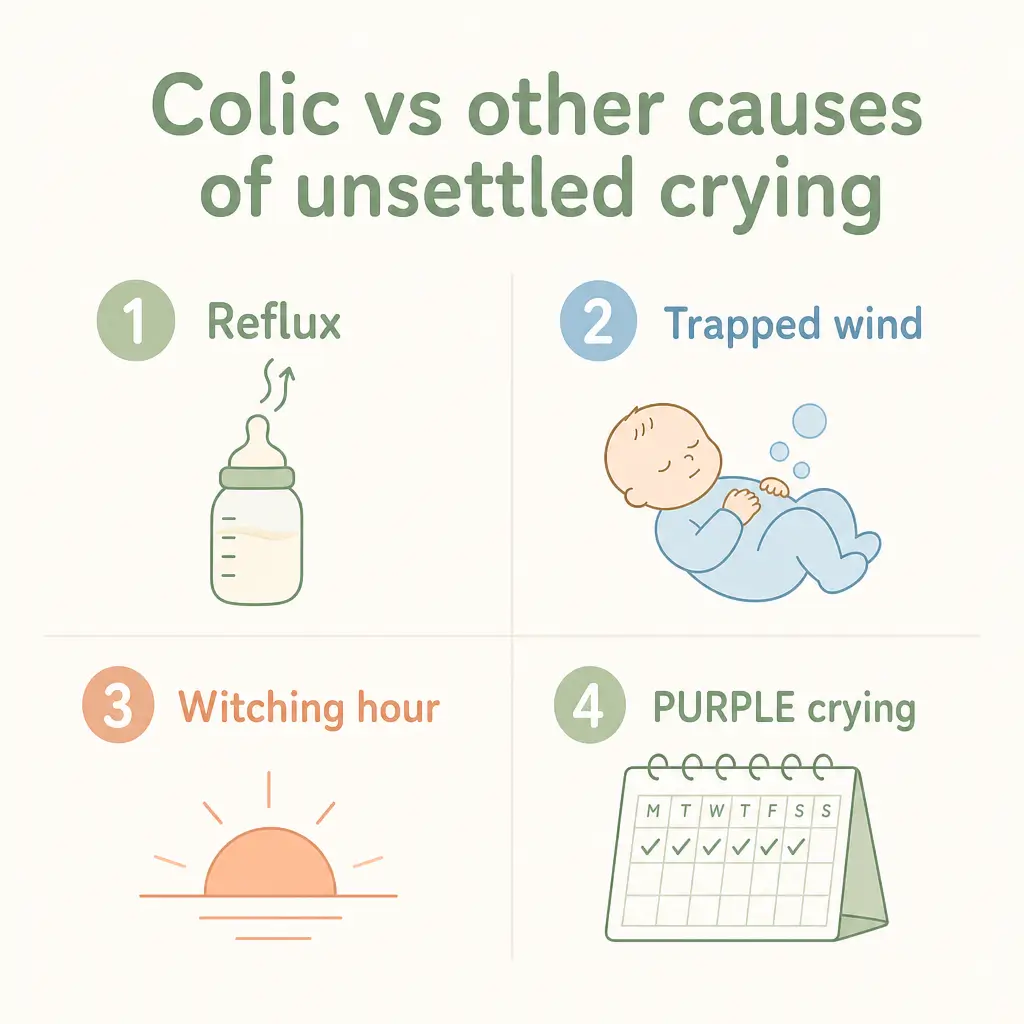
A lot of things in the first few months can look like colic from the outside. The table below is a quick way to compare colic with the other usual suspects.
| Sign | Colic | Trapped wind | Reflux | Witching hour | Normal newborn fussiness |
|---|---|---|---|---|---|
| Duration of crying | Hours, often 1–3+ | Short bouts (minutes) | Variable, often around feeds | 30–60 minutes | Short, scattered spells |
| Time of day | Evening, repeats daily | Any time | Around or after feeds | Late afternoon/early evening | Any time |
| Eases with… | Hard to ease | A good burp or wind passing | Upright holding after feeds | A feed, cuddle, change of scene | Feed, cuddle, sleep |
| Tummy signs | Tight, distended | Audible wind, tight briefly | Less tummy-focused | None specific | None specific |
| Spitting up milk | Not typical | Not typical | Yes—often the main sign | No | Occasional posset |
| Knees pulled up | Yes | Sometimes | Less typical | No | No |
| Pattern repeats over weeks | Yes—3+ weeks | No | Yes—feeds-linked | Often, until ~3 months | Variable |
| Goes by 3–4 months | Yes | n/a | Often improves | Yes | Settles into routine |
A few longer reads if you’d like to go deeper on each:
- Reflux: see our colic vs reflux guide
- Trapped wind: see 10 ways to relieve trapped wind
- The witching hour: see what is the witching hour
- The Period of PURPLE Crying: see purple crying vs colic
Could it be something else more serious?
Some less common things can show up looking like colic. They’re worth knowing about so you know when to call your GP.
- Cow’s milk protein intolerance. Signs can include rash or eczema, vomiting (not just small spit-ups), mucus or blood in the stools, and poor weight gain. Read more about cow’s milk protein intolerance.
- An infection. Fever, lethargy, or a different-sounding cry can be early signs of an infection in a young baby and need to be checked the same day.
- A feeding issue. Tongue tie, poor latch, or an oversupply/undersupply mismatch can cause feed-related discomfort that mimics colic.
If anything feels off, or your baby seems unwell rather than just unsettled, please speak to your GP or maternal child health nurse promptly.
What helps a baby with colic symptoms?

There’s no single trick that works every time, but most parents build up a small toolkit:
- Movement—gentle rocking, walking in a carrier, a short drive, or a baby swing
- The colic carry—holding your baby tummy-down along your forearm, head supported in the crook of your elbow
- Calming the senses—dim the lights, lower the volume, slow your own pace in the late afternoon
- Steady background sound—a fan, soft white noise, or a hairdryer in the next room
- Careful winding during and after feeds. Our best ways to burp a baby walks through several positions
- A warm bath—warmth and gentle support of water can be very settling
- Ingredients traditionally used in Western herbal medicine for wind/gas relief, like those in Infants’ Friend Oral Liquid—a long-standing part of Australian colic routines
For more practical ideas, see our home remedies for colic and tips to soothe a crying baby.
When to seek medical advice
Colic is common and almost always passes on its own. That said, please speak to your GP or maternal child health nurse promptly if your baby:
- Has a fever (38°C or higher in babies under 3 months)
- Is vomiting forcefully or repeatedly
- Has blood or mucus in their stool
- Isn’t gaining weight or is feeding poorly
- Is unusually lethargic or hard to wake
- Has a high-pitched, weak, or continuous cry that feels different to their usual
- Has any signs of breathing difficulty
- Continues to have excessive crying past 4 months of age
Trust your instincts. If something doesn’t feel right, get your baby seen.
How Infants’ Friend can help
Infants’ Friend Oral Liquid has been made in Australia since 1935. The formula contains ingredients traditionally used in Western herbal medicine for colic relief (wind/gas pain), relief from indigestion, and to relieve disturbed or restless sleep. It’s free from alcohol, sugar, and artificial flavours, sweeteners, or colours, and is suitable for use from birth.
You’ll find Infants’ Friend at Coles, Woolworths, and Chemist Warehouse. See our where to buy page for full stockist details.
Frequently asked questions
AUST L 367810. Always read the label and follow the directions for use. If symptoms persist, talk to your health professional.